





Project Background
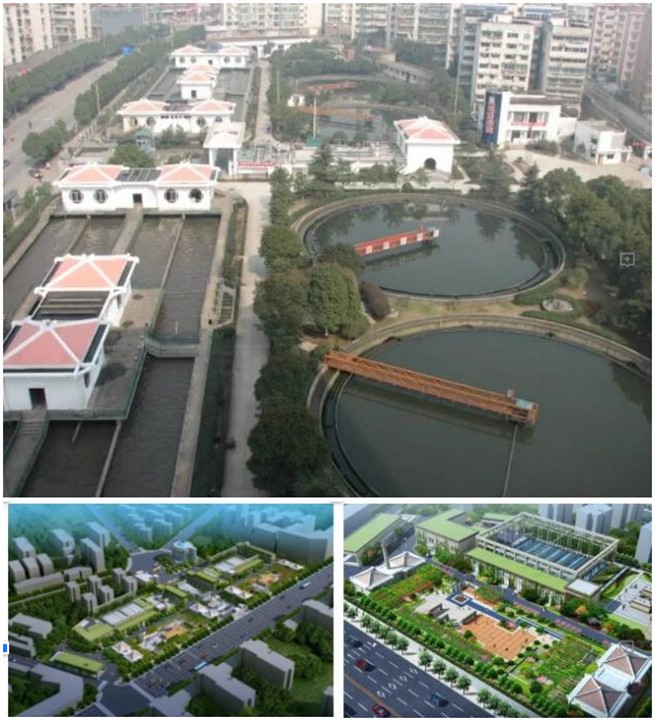
The urban wastewater treatment plant (WWTP) covers an area of 35,000 m² and was originally built in a suburban area surrounded by fish ponds and open space. With the development of urbanization, it is now located in a densely populated residential and commercial area. The odor of sewage and the noise from the plant significantly affect nearby residents.
The plant was originally designed to treat a sewage flow rate of 140,000 m³/day. Its effluent quality must meet the Class 1B of China's "Pollutant Discharge Standard for Urban Wastewater Treatment Plants" (GB 18918-2002).
Before being pumped to the treatment unit, the wastewater undergoes preliminary treatment through a coarse screen, a medium screen, and a fine screen. Primary treatment includes an aerated grit chamber, followed by secondary treatment through an oxidation ditch and a secondary clarifier. Finally, the sewage is discharged to an external well through a 1-meter diameter pipe, from where it flows into a closed box culvert network.
Upgrading Design Plan

Scale and Effluent Quality Targets
Based on feasibility studies, the plant's capacity remains at 140,000 m³/day, with excess wastewater diverted to a pumping station for transfer to another treatment plant. The effluent not only discharges into rivers but also reuses water in nearby lakes. Therefore, the effluent must comply with both Class 1A of GB 18918-2002 and the "Water Quality Standards for Urban Wastewater Reuse in Landscape Environmental Water" (GB/T 18921-2002). Additionally, to prevent eutrophication in lakes, the effluent must meet Class IV standards under the "Surface Water Quality Standard" (GB 3838-2002).
Process Flow Design
The project selected an "AAO + MBR" process for the plant upgrade. The sludge treatment process uses a centrifugal dewatering machine to reduce sludge moisture content to below 80%, and grit and sludge are sent to the city's municipal sludge treatment center.
To determine optimal conditions and operating parameters, comprehensive simulations were conducted using Biowin software based on an Activated Sludge Digestion Model (ASDM), with minimized energy and chemical consumption.

Overall Design
The plant has a limited area of about 33,000 m². We retained its existing structures such as the administration and control building. Production structures that did not meet sewage or construction standards, such as pretreatment, oxidation ditch, sludge dewatering area and control room, were upgraded to varying degrees.
For example, we built an MBR unit to replace the secondary clarifier, integrating functions such as aerobic tanks, membrane tanks, blower rooms and chemical dosing rooms, as well as disinfection tanks. These devices bring its sewage up to the discharge standards for recycled water.
Key Design Parameters of Structures
Pre-Treatment Modifications
1) Coarse Screens
Dimensions: 5.6 m x 8.1 m, height: 4.9 m
Channels: 3, replacing the existing 50 mm coarse screens with 20 mm rotary screens
Channel width: 1.9 m, water depth before screen: 0.95 m, installation angle: 70°, screen gap: 20 mm
2) Medium Screens
Dimensions: 5.8 m x 10.1 m, height: 4.9 m
Channels: 4, upgrading the 15 mm screen machines to 6 mm rotary screens
Channel width: 1.9 m, water depth before screen: 0.70 m, installation angle: 70°, screen gap: 5 mm
3) Fine Screens
Dimensions: 7.1 m x 11.15 m, height: 1.5 m
Upgrading from 6 mm rotary screens to 3 mm perforated plate screens while maintaining the existing channels
Channel width: 2.1 m, water depth before screen: 1.5 m, screen gap: 3 mm
Equipped with 4 perforated plate screens (1.5 kW each) and 2 backwash pumps with a flow rate of 36 m³/h each4) Membrane Screen Modifications
The original sludge return pump room has been repurposed as the membrane screen room. The dimensions of the fine screen are 6.1 m × 8.8 m with a height of 2.2 m. Four membrane screens are installed, with three operational and one on standby, each with a power rating of 1.5 kW. Each channel has a width of 1.4 m, a water depth before the screen of 1.1 m, and a screen gap of 1 mm. Two backwash pumps, each with a flow rate of 36 m³/h and a power of 15 kW, are provided, with operating times set to a 1:2–1:4 open-to-stop ratio.
Oxidation Ditch Modifications
The two existing oxidation ditches have been modified into anaerobic-anoxic tanks, each with a design flow rate of 70,000 m³/day. The anaerobic section has a retention time of 1.0 hours, while the anoxic section has a retention time of 2.7 hours, with an effective water depth of 3.9 m. Each anaerobic tank is equipped with six high-speed submersible mixers with a power of 3.7 kW, while each anoxic tank has twelve low-speed submersible mixers with a power of 2.3 kW. The sludge return ratio from the anoxic to anaerobic tanks ranges from 100% to 200%.
MBR Comprehensive Structure
The four existing secondary clarifiers have been replaced with two new MBR (Membrane Bioreactor) structures, each with a design capacity of 70,000 m³/day. The dimensions of each MBR unit are 82.34 m × 38.18 m and include the following components:

1) Aerobic Tank
Dimensions: 37.70 m × 36.25 m with an effective water depth of 6.0 m
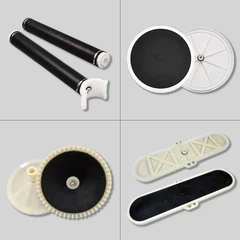
Retention time: 2.4 hours, equipped with 1,216 tubular aerators per tank (2,432 in total across both tanks)
Each aerator has an airflow rate of 7.2 m³/h, and the sludge return rate from the aerobic to the anoxic tank is 300%.
2) MBR Membrane Tank
Total dimensions per tank: 45.46 m × 31.85 m, including distribution, membrane, return channels, and cleaning tanks
Membrane tank depth: 5 m with an effective water depth of 3.7 m
Distribution channel: 39.6 m × 2.1 m, return channel: 39.6 m × 1.5 m
Membrane tank divided into eight cells, each 26.65 m × 4.6 m, with three cleaning cells for water, acid, and alkaline cleaning
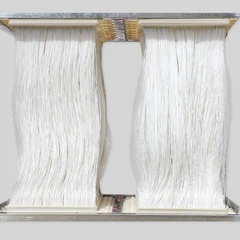
Each tank has eight rows, six with ten PVDF hollow fiber membrane modules, and two with nine modules
The design capacity per membrane module is 897.5 m³/day, with a flux of 17.81 L/(m³·h) and an aeration rate of 849.6 Nm³/min, maintaining an air-to-water ratio of 8.7:1
The sludge return rate from the membrane tank to the aerobic tank is 400%.
3) Sludge Return Pump Room
Two pump rooms, each 10.9 m × 8.51 m, with eight return pumps
Four pumps transfer sludge from the membrane to the aerobic tank (Q=2,910 m³/h, H=0.5 m, N=18.5 kW)
Four pumps return sludge from the aerobic to the anoxic tank (Q=2,190 m³/h, H=3.0 m, N=37 kW)
4) Comprehensive Equipment Room
Two-story steel-concrete + frame structure, 44.5 m × 6.61 m
Upper floor: MBR system control room and dosing facilities for sodium hypochlorite and citric acid
Lower floor: 9 water pumps (8 in use, 1 as backup, variable frequency, Q=493 m³/h, H=11–13 m, N=22 kW) and 4 sludge pumps (3 in use, 1 standby, Q=80 m³/h, H=20 m, N=11 kW)
5) Blower Room
Built above the aerobic tank, dimensions of each blower room: 38.46 m × 7.8 m
Each room has three aeration blowers (one large and two small, interchangeable for redundancy)
Large blower: Q=146 m³/m, H=7.5 m, N=223 kW
Small blower: Q=73 m³/m, H=7.5 m, N=112 kW
Four membrane blowers (two large and two small, with redundancy between a large and two small blowers)
Large blower: Q=213 m³/min, H=4.5 m, N=223 kW
Small blower: Q=106.5 m³/min, H=4.5 m, N=112 kW
Disinfection Contact Tank / Dosing Room / Effluent Lift Pump Room
The disinfection contact tank, dosing room, and effluent lift pump room are combined into a single structure with a capacity of 140,000 m³/day. The disinfection contact tank has a total footprint of 25.05 m × 23.35 m, with a height of 4.9 m and an effective depth of 4.0 m, resulting in an effective volume of 2,300 m³. The contact time is 23.66 minutes, with an additional 7.12 minutes in the effluent pipe, for a total contact time of 30.78 minutes. Four submersible pumps are installed (3 operational, 1 standby), each with Q=2,000 m³/h, H=16 m, and N=132 kW.
The dosing room, located above the disinfection tank, uses chlorine dioxide as the disinfectant at 8 mg/L. Solid polyaluminum chloride (PAC) is dosed at a maximum rate of 30 mg/L for chemical phosphorus removal, and sodium acetate is used as an external carbon source to enhance TN removal, with a maximum dosing rate of 30 mg/L.
Sludge Storage Tank
The newly constructed sludge storage tank is an underground reinforced concrete tank with a footprint of 9.0 m × 9.0 m and an effective water depth of 5 m, providing an effective volume of 405 m³. A submersible mixer is installed inside the tank to ensure stable dewatering performance by mixing during sludge dewatering. The tank is also equipped with an ultrasonic sludge level meter, allowing real-time display of the sludge volume in both the central control room and the dewatering area. The feed sludge pump can be stopped when the sludge level is too high, and the mixer stops when the level is low.
Sludge Dewatering Room Renovation
Previously, a belt dryer was used for sludge treatment. After upgrading, the original belt dryer met the sludge dewatering capacity requirements, but odor issues associated with sludge could not be adequately addressed. Therefore, centrifugal dewatering machines are introduced to replace the belt dryer. Four horizontal spiral settling dewatering machines are designed, with three in use and one as backup, working for 12 hours per day. Each machine has a capacity (Q) of 60 m³/h and power (N) of 66 kW.
Odor Control System
Due to limited land availability at this wastewater treatment plant, the project adopted on-site decentralized odor treatment, with six locations designated:
1. Odor Control System 1: Targets odors from the pretreatment area, using a plant-based deodorizing system with a capacity of 6,200 m³/h.
2. Odor Control System 2: Designed for the sludge dewatering room and sludge storage tank, with a plant-based deodorizing system capacity of 4,500 m³/h.
3. Odor Control System 3: Targets odors from the anaerobic/anoxic tanks. Each tank has a total treatment capacity of 13,000 m³/h. Due to space constraints in the room housing the tanks, two biofiltration odor control systems, each with a capacity of 6,500 m³/h, are installed in two separate rooms on the tank structure. The two units share a single exhaust stack and can operate independently.
4. Biological Odor Control Equipment 4: Designed for two MBR integrated structures, with two biofiltration units installed on top of the aerobic tanks, treating odors at a total capacity of 43,000 m³/h to save space.
Discussion on Green Design Concepts in Wastewater Plant Design
1. AquaSust uses a variety of plants to create multi-layered, multi-form plant configurations to demonstrate the ecological impact of the plant community.
Secondly, the plant is located in the center of the education zone, and we set up a ceramic water feature at its main entrance. The treated water is reused for landscaping to enhance people's awareness of water conservation and environmental protection.
2. In terms of landscape and green space design, our theme of "saving resources and protecting the environment" is consistent with the low-impact development concept of "sponge city". AquaSust's innovative initiatives include green roofs, vertical greening and environmentally friendly parking lots.
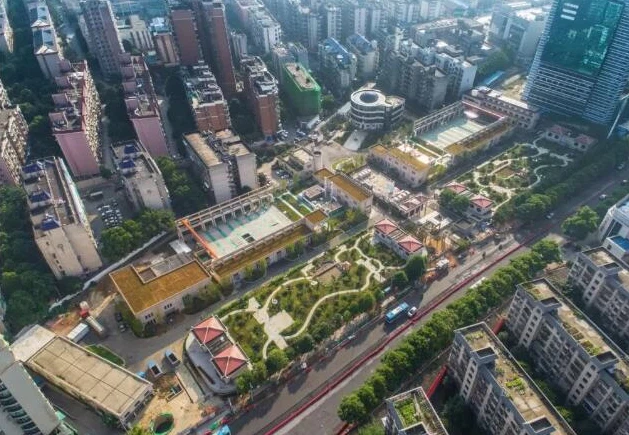
We also cover the oxidation ditch with soil to create an urban "mini park" that reflects the ecological beauty and harmony between man and nature. The "sponge city" concept can be used as a thermal insulation material for buildings and reduce roof runoff and pollution.
Water Quality Treatment Results

After the quality improvement project, the upgraded wastewater treatment plant officially began operation in December 2016. The average inflow and outflow water quality from January to December 2017 is shown in Table 2.
Summary of Comprehensive Benefits Analysis
Land Savings
The project covers a total area of 34,991.54 m², with a land-use indicator of 0.25 m²/(m³∙d), just 25-30% of the 0.80–0.95 m²/(m³·d) specified in the 2001 *Standards for Urban Sewage Treatment Engineering Project Construction* for secondary biochemical + advanced treatment processes, saving over 77,000 m² of land and approximately 170 million CNY.
Energy Savings
The project's treated sewage electricity consumption is 0.46 kWh/m³, compared to 0.50–0.60 kWh/m³ in existing domestic plants with membrane treatment processes, representing a reasonable low-energy consumption level. Annual energy savings amount to at least 2 million kWh, with electricity cost savings of approximately 1.6 million CNY.
Water Conservation
The project's effluent, after advanced treatment, can be optionally reused as lake water during autumn and winter, reducing reliance on tap water. This approach conservatively saves about 4 million m³ of water annually.
Material Savings
The design reuses existing facilities (e.g., guardhouse, main building, pretreatment area, oxidation ditches, sludge dewatering room, and central control room), saving around 80 million CNY in investments. The use of PAC and carbon sources remains below 30 mg/L, compared to around 50 mg/L in similar projects, saving approximately 20 mg/L. Annual savings in PAC and carbon sources total around 1,000 tons or 2.5 million CNY.
Environmental Benefits
The quality upgrade significantly reduces pollutants discharged into rivers. At a treatment scale of 140,000 m³/d, it is estimated to reduce pollutants by the following annual amounts: CODCr by 13,100 t, BOD5 by 4,740 t, SS by 8,320 t, TN by 960 t, and TP by 140 t.
Ecological Landscape Benefits
The project provides full-scale odor and noise reduction for the plant while enhancing the plant's overall landscaping, transforming it into an urban garden that greatly improves the quality of life for nearby residents.
Conclusion
AquaSust completed the plant's wastewater treatment project through the "AAO + MBR" process based on the green, circular, and low-carbon wastewater treatment concept.
Despite challenges such as limited land, environmental sensitivity, and strict emission standards, operating data shows that we have successfully achieved the multiple goals. These include improving water treatment standards, recycling and reusing wastewater, optimizing odor and noise reduction, as well as improving the overall landscape.