





Quality Control Measures For Raw Materials

Supplier Audit
By evaluating the qualifications, reputation and production capacity of suppliers, we screen out qualified suppliers. This can reduce the procurement risks and the defective rate of raw materials by about 5 - 15%.
Raw Material Acceptance
- Chemical Composition: Analyze its chemical composition to ensure that it meets the usage standards.
- Physical Properties: Test the density, melting point, tensile strength, etc. of the raw materials.
- Appearance Quality: Check the appearance defects of the raw materials, such as cracks, bubbles, impurities, etc.
Material Composition Analysis
We use instruments like spectrometers and chromatographs to analyze and compare with the requirements of standard compositions to determine various components and their contents in the raw materials. Then, we can adjust the formula in a timely manner.
Physical Property Test
- Tensile Testing Machine: It is used to test the tensile strength and elongation at break of the raw materials.
- Hardness Tester: It measures the hardness of the raw materials.
- Densitometer: It tests the density of the raw materials.
Thermal Properties Testing
Thermal property testing refers to observing the melting point and thermal stability of materials through methods like thermogravimetric analysis. Because they need to prevent deformation in a thermal environment.
Chemical Resistance Test
Immerse the materials in different chemical solutions and observe their changes and performance losses. Only the materials screened through testing can avoid corrosion in the process of sewage treatment.
Batch Consistency Check
Conduct sampling and comparison on various performance indicators of multiple batches of raw materials to avoid quality fluctuations during the production process.
Quality Control Measures For Production
Production parameter adjustment
Before production starts, AquaSust's technicians will set the temperature, pressure, time and other parameters of the production equipment according to the standard. For example, in MBBR production, the reaction temperature is generally set between 180℃ and 200℃, and the reaction time is guaranteed to be 3 hours. This allows the raw materials to be fully integrated, and the strength and porosity of the finished product meet the standards.
Equipment calibration
Calibrate key equipment regularly. For example, use a pressure calibrator to calibrate the pressure so that it stabilizes between 80MPa and 100MPa. This index can ensure the molding quality and dimensional stability of the product. Current error control within ±5A and voltage error control within ±2V can prevent defects such as cold welding and leaking welding.
First piece inspection
At the beginning of each batch of production, the first product is inspected, such as height, diameter and other dimensions. At the same time, its appearance should be smooth, without obvious scratches, pores and other defects, and the color should be consistent.
Process control
During the production process, set up multiple quality inspection nodes. For example, for MBBR products, we generally conduct random inspections every 5 products. The weight of the sampled products must be within the standard weight ±3g range, and the compressive strength must meet the requirement of ≥8MPa.
Finished product inspection
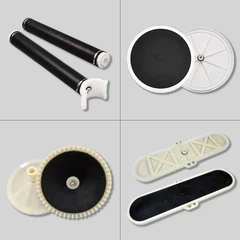
After all products are completed, they are fully inspected according to the finished product inspection standards. For example, the aeration diffusers need to undergo a corrosion resistance test, that is, after being immersed in a 5% sodium chloride solution for 72 hours, there must be no obvious signs of corrosion on the surface before they can be packaged and put into storage.

Quality Testing Content
1. Appearance Inspection:
With the help of a strong flashlight and a visual magnifying glass, check the surface of the product for cracks, bubbles, impurities and color differences. They should be smooth and uniform in color.
2. Dimension Measurement:
We use measuring tools such as calipers and micrometers to measure whether the length, diameter, thickness, etc. of the product are within the allowable range. Otherwise, they are difficult to adapt to other equipment components.
3. Density Testing:
This refers to the use of drainage method or professional density measuring instruments to measure the density of the product under standard temperature and pressure conditions, and measure the average value multiple times.
4. Buoyancy Test:
It completely immerses the product in an aqueous solution that simulates the working conditions of a bioreactor, and uses a force sensor to measure the buoyancy it is subjected to. By comparing with the theoretical calculated value, it is determined whether they can be stably suspended and maintain a good fluidized state.
5. Compressive Strength Test:
On the universal material testing machine, axial pressure is applied to the product at a predetermined loading rate until the product is destroyed or reaches the specified deformation. This can verify that they can withstand the corresponding pressure in actual use.
6. Surface Area Measurement:
The specific surface area of the product is measured by gas adsorption to ensure that they can provide sufficient attachment space for microorganisms to grow biofilms.
7. Chemical Resistance Test:
At this time, we need to soak the product in acidic, alkaline and salty wastewater treatment chemical medium solutions respectively. After the set temperature and time, take it out and check the weight and size changes of the product to evaluate its corrosion resistance.
8. Abrasion Resistance Test:
In this step, we make the product and the specific friction material undergo a friction cycle test at the specified pressure, speed and stroke. After that, measure the wear of the product and observe the surface wear condition.
9. Aging Test:
Place the product in an accelerated aging test chamber to simulate the environmental conditions such as temperature, humidity, and light during long-term use, and conduct an aging test for a certain period of time. Then we compare its strength, density, and appearance with the previous ones to observe its durability.
Testing Equipment Used
Microscope: used to detect whether there are cracks, bubbles, impurities and other small defects on the product surface.
Vernier calipers and micrometers: used to accurately measure the dimensions and tolerances of the product.
Gas tightness testing equipment: used to detect the gas tightness of the disk aerator.
Pressure test equipment: used to test the performance of the product under different pressure conditions.
Flow tester: used to test the aerator in different air pressure under the gas flow.
Chemical corrosion resistance test equipment: used to detect the corrosion resistance of the product in different chemical media.
Fatigue testing machine: used to test the fatigue resistance of the product in long time operation.
Tensile testing machine: used to test the tensile strength of the material.
Hardness Tester: Used to measure the hardness of the product material.
Water immersion test tank: used to immerse the product in water to detect its stability and performance changes in long-term use.

