





Moving Bed Bioreactor (MBBR) Design Guidelines
AquaSust provides you with one-stop customized services from raw material production, mold development to automated production of MBBR media, including CAD design/3D drawings/OEM, ODM services.
For different wastewaters, we design MBBR media that meet your needs, or develop new filter media according to your drawings.

Design Basis


When designing MBBR (Moving Bed Biofilm Reactor) products, the following are the main parameters we refer to and the factors considered:
Reference Parameters:
1. Surface Area: The specific surface area of the culture medium determines the space available for biofilm attachment in the medium. High specific surface area allows more bacteria to attach and grow to remove pollutants.
2. Porosity: High porosity allows water to flow through the medium more easily, improving the exchange rate of oxygen and waste.
3. Density: The density of the medium should be appropriate so that it can move freely in the reactor without sinking or floating.
4. Compressive strength: Only the strong media can resist mechanical wear and the effects of bioburden in long use.
Considerations:
1. Material selection: Common materials include polyethylene and polypropylene. They are not only corrosion-resistant, but also biocompatible.
2. Media shape: The shape of the media affects the direction of water flow and the uniformity of the biofilm. Common options include round, axial, or other complex shapes.
3. Environmental adaptability: When designing, we should consider the working environment of the MBBR media, including municipal wastewater, industrial wastewater, or high-intensity wastewater treatment.
4. Biofilm maintenance: The biofilm can only effectively remove pollutants if it can achieve stable attachment, continuous growth, and natural shedding on the media.
5. Scalability and modularity: The media design should be easy to expand and modularize to adapt to different applications.
Typical MBBR Specifications
| No. | Item No. | Diameter * Height | Surface Area | Rooms | Number of units per m³ | Applicable Wastewater Treatment |
| 1 | AS-MBBR 04 | 11 mm * 7 mm | >900 ㎡ / m³ | 4 Rooms | 940000pcs | |
| 2 | AS-MBBR 05 | 11 mm * 7 mm | >1000 ㎡ / m³ | 5 Rooms | 980000pcs | |
| 3 | AS-MBBR 06 | 16 mm * 10 mm | >800 ㎡/ m³ | 6 Rooms | 260000pcs | |
| 4 | AS-MBBR 08 | 10 mm * 5 mm | >3500 ㎡/ m³ | 8 Rooms | 1540000pcs | |
| 5 | AS-MBBR 19 | 25 mm * 12 mm | >650 ㎡/ m³ | 19 Rooms | 118000pcs | |
| 6 | AS-MBBR 37 | 25 mm * 12 mm | >800 ㎡/ m³ | 37 Rooms | 118000pcs | |
| 7 | AS-MBBR 38 | 25 mm * 10 mm | >800 ㎡/ m³ | 38 Rooms | 118000pcs | |
| 8 | AS-MBBR 40 | 15 mm * 15 mm | >900 ㎡ / m³ | 40 Rooms | 230000pcs | |
| 9 | AS-MBBR 61 | 25 mm * 4 mm | >1250 ㎡ / m³ | 61 Rooms | 20000pcs | |
| 10 | AS-MBBR 64 | 25 mm * 4 mm | >1200 ㎡/ m³ | 64 Rooms | 20000pcs | |
| 11 | AS-MBBR 78 | 25 mm * 4 mm | >1600 ㎡ / m³ | 78 Rooms | 210000pcs |
MBBR Media Design Services
1. structures
We provide customized MBBR structures, including spherical, cylindrical, and cubic media shapes. Or grilles designed inside to support carriers, guide plates to improve water flow, etc.
2. Size
The size affects the specific surface area, porosity and hydraulic properties of the carrier. Among them, small media is conducive to microbial attachment, but increases hydraulic resistance, while large carriers are the opposite.
3. Materials
For different wastewater pollutants (organic matter, nitrogen, phosphorus, etc.) and treatment scales, the materials of these media are available in PE, PP, HDPE and other materials.
4. Carrier surface
We also allow you to specify the roughness, hydrophilicity/hydrophobicity and other characteristics of the carrier surface. This is conducive to microbial attachment, better contact with water, and nutrient transfer.
MBBR Design Steps
Once you opt to collaborate with us on MBBR media design, it will be carried out with the subsequent procedure:
1.Initial consultation and site assessment - 2.Concept design - 3.Initial development - 4.Process design - 5. Equipment specification - 6.Integration with existing infrastructure - 7.Detailed design and documentation - 8.Review and approval process - 9.Commissioning - 10.Post-installation support
Our Service Advantages
When a wastewater treatment client works with us to develop an MBBR wastewater system, they receive the following benefits:
1. High Production Standards:
AquaSust has been designing and manufacturing MBBR media with high specifications and quality standards, and manufacturing its own diffusers to optimize quality.
2. Matched Diffusers:
We specifically design fine bubble diffusers that match the media and maintain compatibility with the media.
3. Years of Experience:
We have decades of experience in MBBR design and manufacturing. Whether you are in the food, textile and oil processing or pulp and paper industry, you can fully rely on us.
4. Practical Solutions:
AquaSust has developed a variety of resin materials, diffuser sizes and coatings. In addition, we understand all MBBR media failures and have the ability to help you solve them.
5. SOTE Resource Library:
We have established a large resource library for Standard Oxygen Transfer (SOTE) tests. They can be used to help you optimize MBBR system design and oxygen delivery performance.
6. IFAS Experience:
We are good at processing fixed film activated sludge (IFAS) and can provide fixed media for it. It requires less volume, maintenance and cost than traditional activated sludge systems.
Want to Learn More?
Reach out and work with our team, at pro@aquasust.com.
Aeartion Diffuser Design Guidelines
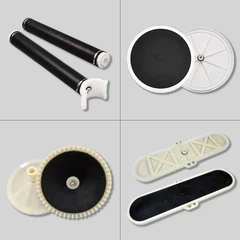
AquaSust offers you all-round customized services, involving CAD design, 3D drawings, and OEM, ODM service. This covers raw material production, molds development and automated manufacturing of aeration diffusers, etc.
For various wastewater types, we're capable of designing tailored diffusers to your specific requirements. Alternatively, we also develop new aeration diffusers based on your provided drawings.

Design Basis
When designing aeration diffusers, we follow many product parameters and factors, the main ones are as follows:
Reference Parameters:
1. Oxygen Transfer Efficiency (SOTE): The SOTE value is used to measure diffuser performance and refers to the percentage of oxygen that can be transferred from the aeration system to the water column.
2. Pore Size: The size of the pores on its surface determines the size of the bubbles. Smaller bubbles provide a larger gas-liquid contact area, which can increase the oxygen dissolution rate faster.
3. Diffusion Area: This affects the uniformity of gas distribution and the efficiency of the reaction of oxygen and other suspended matter in the sewage.
4. Material Durability: This affects the uniformity of gas distribution and the efficiency of the reaction of oxygen and other suspended matter in the sewage.
Considerations:
- Water conditions: Consider the type of water environment (e.g. fresh water, salt water, industrial wastewater, etc.) in which the aeration diffuser is located. Different water qualities may have different requirements for its materials.
- System compatibility: The diffuser needs to be compatible with the existing aeration system. This can be designed from the pipe connection size, pressure requirements, and installation methods.
- Energy efficiency considerations: The design should optimize energy usage costs, such as increasing its aeration efficiency through a denser surface hole design.
- Maintenance: The diffuser design should consider easy cleaning and replacement, including the use of membrane materials that are not prone to clogging.
- Cost-effectiveness: The design and material selection should meet budget requirements without compromising product performance.

Typical Diffuser Design Specifications
|
Model |
AS-DD215 |
AS-DD270 |
AS-DD350 |
|
Image |
 |
 |
 |
|
Bubble Type |
Fine Bubble |
Fine Bubble |
Fine Bubble |
|
Plate Diameter |
215mm |
270mm |
350mm |
|
Membrane Diameter |
8 inch |
9 inch |
12 inch |
|
Membrane Material |
EDPM, Rubber, Silicone |
||
|
Base Material |
ABS, ABS + Glass Fibre, PP PP+ Glass Fibre |
||
|
Connector |
3/4"NPT male thread |
||
|
Weight |
0.42KG |
0.62KG |
1.14KG |
|
Plate Color |
Black, White, Gray, Black |
||
|
Membrane Thickness |
2mm |
2mm |
2mm |
|
Bubble Size |
1-2mm |
1-2mm |
1-2mm |
|
Design Flow |
1.5-2.5 m³/h |
3-4 m³/h |
5-6 m³/h |
|
Flow Range |
1-6 m³/h |
1-8 m³/h |
1-12 m³/h |
|
SOTE |
≥38% |
≥38% |
≥40% |
|
(6m submerged) |
|||
|
SOTR |
≥0.31kg O2/h |
≥0.45kg O2/h |
≥0.75kg O2/h |
|
SAE |
≥8.9kg O2/kw*h |
≥8.9kg O2/kw*h |
≥8.9kg O2/kw*h |
|
Headloss |
1500-4300Pa |
1500-4300Pa |
1500-4300Pa |
|
Service Area |
0.2-0.64 ㎡/pcs |
0.25-1.0 ㎡/pcs |
0.4-1.5 ㎡/pcs |
|
Service Life |
> 7years |
||
| Item number | AS-TD63 | AS-TD93 | AS-TD113 |
| Image |  |
 |
 |
| Bubble type | Fine Bubble | Fine Bubble | Fine Bubble |
| Tube diameter(mm) | 63 | 93 | 113 |
| Material | Special Formula EPDM with UV Protector import from Germany /Silicon Membrane | ||
| Tube material: Acrylonitrile-butadiene-styrene with UV Protector (ABS) | |||
| Length | 500/750/1000mm | 500/750/1000mm | 500/750/1000mm |
| Connector | 3/4NPT | 3/4NPT | 3/4NPT |
| Flow range(m³/h) | 2-14 | 5-20 | 6-28 |
| Bubble Size(mm) | 1-2 | 1-2 | 1-2 |
| Service Area(m²) | 0.75-2.5 | 1.0-3.0 | 1.5-2.5 |
Aeration Diffuser Design Service
Membership Plans
Choose the plan that suits you best with belows.
1. Shapes Options:
Disc, tube, and plate structures are common shapes for these diffusers. They are specially designed for different aeration tanks. Like, the tube diffuser is more suitable for narrow tank bodies.
2. Bubble Size:
You can specify the bubble size for these diffusers. The common range is between 1-5mm. This is achieved by adjusting parameters such as the pore size and aeration pressure of the diffuser.
3. Material Selection:
Our aeration diffusers are available in various materials, such as ABS, PP, stainless steel, etc. Their membrane materials include EPDM, silicone, and rubber. You can choose for different water qualities and working conditions.
4. Appearance Design:
To make your wastewater aeration project more recognizable, we provide appearance customization for these aeration diffusers. This involves exclusive logos and a rich variety of standard color versions.
Design Process
The customization of aeration diffusers is mainly divided into the following steps:
Phase One: Requirements Analysis
Our engineering team will conduct an initial communication with the client to understand their specific requirements for the aeration diffuser, such as the aeration environment and oxygen transfer efficiency. At this stage, we will formulate a time and budget schedule for the project.
Phase Two: Design and Development
During this step, parameters such as the diffusion area, pore size, and material are determined. Designers will use software like CAD to create a prototype based on the design drawings.
Phase Three: Production and Optimization
A small batch of products will be manufactured for laboratory testing to verify their oxygen transfer efficiency and durability. Based on the results, we will provide feedback to the client and adjust the design.
Phase Four: Final Production and Delivery
Once the final design is confirmed, mass production begins. We conduct random inspections at each step to ensure that it complies with technical specifications and quality standards. Then, we carefully package the products and deliver them to the client on time.
Phase Five: Post-Sale Support and Service
Installation guidance, technical support, operation and maintenance training, and optimization suggestions are all part of the after-sales service we provide for you. We also welcome your feedback on the use to continuously improve the product design.
Our Service Advantages
When wastewater treatment customers work with us to develop an Aeration Diffuser wastewater treatment system, they receive the following benefits:
1. Strict Quality Control:
We design and manufacture aeration diffusers in accordance with strict specifications and quality standards.
2. Complete Accessories:
Our fine bubble diffusers can be supplied with matching accessories and are fully compatible.
3. Industry-specific experience:
With decades of experience in integrated fixed-film activated sludge (IFAS), we have successfully designed and implemented efficient aeration solutions for industries such as textile, pulp and paper, and chemical.
4. Superior Product Materials:
AquaSust only selects high-quality raw materials for product production. Actual tests show that their service life is 15 - 30% higher than the market average.
5. SOTE Database:
We have established an extensive standardized oxygen transfer efficiency (SOTE) testing database to help optimize the design of your aeration system at any time.
6. Perfect After-Sales Service:
You will also receive a quick-response after-sales service, including equipment installation and commissioning, maintenance inspections, etc. Long-term surveys show that our after-sales service satisfaction rate reaches 98.5%.
Want to Learn More?
Reach out and work with our team, at pro@aquasust.com.
Tube Settler Design Guidelines
From CAD design to finished product, we supply you with Tube Settler that meets your individual needs. That's done with our mature 3D drawings/patented extrusion technology/OEM, ODM experience.
Whether you want a standard product or develop a new specification based on a drawing, we can help you realize it.

Design Basis
When designing a tube settler, we often consider a lot of things, such as:
Product Parameters:
1. Settling Angle: Only a suitable settling angle can allow solid particles to settle smoothly along the tube wall to the bottom under the action of gravity. This is determined by the particle size, density and flow rate of the liquid. Generally speaking, an angle of 50-60° is the most widely used parameter.
2. Tube Size: This includes the tube size (mainly the tube diameter and tube length). Among them, the tube diameter affects the flow state of the liquid in the tube. The tube length represents the settling distance provided for the solid particles. It determines whether the silt and water can be separated.
3. Material Thickness: If the material thickness is insufficient, the tube may deform and rupture, resulting in material leakage. However, too thick material will increase costs.
Considerations:
1. Operating environment: This mainly refers to temperature and pressure. The former affects liquid viscosity and particle settling speed, while the latter determines liquid flow and particle distribution.
2. Installation Layout: Given the potentially limited actual space in the aeration tank, settlers of varying sizes and shapes can be integrated and installed. This can be achieved by adjusting their positions and opting for either vertical or horizontal installations.
3. Cost: The choice of materials has an influence on cost. We will select more cost-effective raw materials for you, provided that the settling performance of the product is ensured.
4. Environmental Protection: The installation of sludge collection tanks, ventilation, and monitoring alarm devices serves to prevent liquid leakage and improper disposal of solid waste. Additionally, it contributes to reducing the frequency of maintenance required for tube settlers.
Typical Tube Settler Specifications
|
|
Size (mm) |
Thickness (mm) |
Quantity Specific pes/m |
Surface Area (mm) |
|
| φ35 | 0.40 | 62 | 109 | ||
| 0.45 | 62 | 109 | |||
| φ50 | 0.50 | 42 | 109 | ||
| 0.40 | 42 | 87 | |||
| 0.45 | 30 | 87 | |||
| 0.50 | 30 | 87 | |||
| 0.60 | 30 | 37 | |||
| φ80 | 0.70 | 20 | 50 | ||
| 0.80 | 20 | 50 | |||

| Model | A | B | C | D | Material | Service Life | Surface Area | Gravity |
| D35 | 40MN | 20MM | <20MM | φ35MM | PP+UV | 5-10Years | >95m²/m³ | 0.92g/cm³ |
| D50 | 60MM | 28MM | <30MM | φ50MM | PP+UV | 5-10Years | >95m²/m³ | 0.92g/cm² |
| D80 | 80MM | 35MM | <45MM | φ80MM | PP+UV | 5-10Years | >95m²/m³ | 0.92g/cm³ |
Tube Settler Design Service
Tube Settler Design Process
Here is the main process o designing AquaSust's tube settler:
1. Requirements Analysis
We first understand the customer's project requirements and evaluate relevant water quality parameters such as flow rate and settling rate. We then develop a project timeline and budget based on the customer's constraints and installation scope.
2. Prototype Design
At this point, the engineering team needs to determine parameters such as the settler angle, size, material thickness, etc. They use CAD software and computational fluid dynamics (CFD) to design the settler prototype structure.
3. Testing and Optimization
Test the performance of product samples in real scenarios in the laboratory and on-site, and optimize product parameters that are insufficient in the test.
4. Manufacturing and Installation
Once the design is confirmed by the customer, we start mass manufacturing. Every link will be strictly monitored and product sampling will be carried out.
5. Post-Installation Support
We will provide customers with training on how to install, clean and maintain the tube settler. If the product has non-human quality problems during the warranty period, you will receive a free replacement service.
Our Service Advantages
When wastewater customers work with us to develop a Tube Settler wastewater treatment system, they receive the following benefits:
1. Strict Quality Control:
Strict quality control: Every process in AquaSust is strictly tested during product research and development, design, production, inspection, installation and commissioning, and after-sales.
2. Tube Settler Accessories:
We excel in designing complete tube settler compatible tube settler systems, including brackets, baffles, flumes and weirs, and protective surface gratings.
3. Patented Design:
Each plate settler is improved by a patented top flow control angle design. They control head loss and clogging issues.
4. Rich Project Experience:
We use decades of experience to design a tubular settler for your specific application. Many variables were considered, including space, geometry, and simulation test data.
5. SOTE Library:
We have an extensive library of Standardized Oxygen Transfer (SOTE) tests. Whether your project is a wastewater treatment plant, lagoon or aquaculture, you can rely on our data calculations.
6. IFAS Experience:
In addition to the design and production of water treatment products, AquaSust also conducts long-term research on water-related topics, such as the IFAS process.
Want to Learn More?
Reach out and work with our teamReach out and work with our team, at pro@aquasust.com.