





Project Background
- Problem: The treatment system of a sewage treatment plant has reached the end of its service life, and there are problems such as normal attenuation of magnetic flux, fiber breakage, and reduced production capacity.
- Goal: Build a membrane system with a capacity of 50,000 m³/day, including related equipment.
- Difficulties: 1. Achieve Class A sewage quality standard 2. Remove nitrogen and phosphorus in the biochemical process
With the requirements of urban development, environmental monitoring and black and odorous water treatment, the demand for wastewater treatment around sewage treatment plants has increased. Its MBR membrane system has been in operation since 2013, using submerged PVDF hollow fiber ultrafiltration membrane components with a pore size of 0.1 μm. The sewage treatment plant has a designed treatment capacity of 10,000 cubic meters/day and adopts AAO+MBR process. The treated effluent meets the Class A standard of the Pollutant Discharge Standard for Urban Sewage Treatment Plants (GB 18919-2002). At present, it needs to upgrade the MBR membrane system to meet production and social needs.
Overview of the Wastewater Treatment Plant

Process Flow
The process flow, as shown in Figure 1, includes primary treatment using coarse and fine screens, aerated grit chambers, and membrane screens to remove inorganic matter and protect the MBR system with 1 mm spacing in the membrane screens. Secondary treatment employs the AAO+MBR process, including a pre-anoxic tank and enhanced chemical phosphorus removal in the aerobic tank as needed. The effluent is disinfected with UV before being discharged. Sludge treatment consists of physical thickening and deep dewatering by plate frame to achieve 50-60% moisture content before external disposal.
Influent and Effluent Quality
The plant is designed to achieve Class A effluent quality standards. As the inflow includes stormwater, influent concentrations can vary, requiring a focus on nitrogen and phosphorus removal in the biochemical process.

Current Status and Issues in the MBR Membrane System
MBR System Equipment Condition
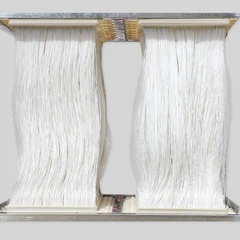
MBR Membrane Pool and Equipment Room*: The MBR membrane pool, connected to the AAO and UV disinfection pools, consists of two rectangular underground tanks with 11 cells per group, each cell containing 8 membrane cassettes (totaling 176 sets of PVDF fiber membranes with <0.1 μm pores and a total surface area of approximately 281,600 m²). The system operates with 22 independently controlled production units divided into two separate systems for easy maintenance, allowing both online and offline cleaning. The equipment room houses production, vacuum, backwash, and sludge pumps, along with air scrubbers using 4 air suspension centrifugal blowers (3 operating, 1 standby; parameters: Q=208 Nm³/min, P=50 kPa).
Chemical Cleaning Room*: Located above the production area, it includes 3 chemical storage tanks for acid, alkali, and NaClO for the MBR system.
MBR Operational Mode*: Membrane pools operate in an 8-min production and 2-min air scour mode. Each pool undergoes hourly CEB (online cleaning) involving a 10-min chemical wash, a 15-min pause, a 5-min wash, an 8-min rinse, and a 17-min pause. Offline cleaning is conducted weekly on one membrane pool.
Issues and Causes in the MBR Membrane System
The main problems include flux reduction/reduced capacity/fiber breakage and clogging/increased cleaning frequency and intensity. The reasons include:
1. The membrane reaches the design life - performance declines, affecting flux and capacity
2. Excessive manual cleaning frequency and intensity - causing fiber breakage and shedding, reducing effective membrane area
3. Irreversible scaling, increased transmembrane pressure - affecting flux
4. Increased cleaning - reducing effective operating time, resulting in reduced production capacity
5. Early maintenance, improper cleaning - exacerbating membrane degradation
Solutions
1. General Approach
Upgrade will maintain the existing cassette dimensions while modifying the internal structure and replacing current modules with higher flux PVDF ultrafiltration membranes (<0.1 μm).
2. Design Calculations
Current Flux*: Each membrane cell has 8 cassettes with a membrane area of 12,800 m² per cell, and the current flux ranges from 7.8 to 15.6 L/(m²·h).
Operating Parameters*: The system will continue with the 8-min on/2-min off operation, with one membrane pool offline for cleaning each day and another undergoing hourly online cleaning. To achieve capacity goals, the total membrane area per side must be at least 140,800 m², with flux requirements between 13.6-22.7 L/(m²·h).

3. Upgrade Plan
Replacing current modules with higher-performance membranes, updating associated equipment, and maintaining original cassette, piping, and aeration structures. The new modules have a minimum flux requirement of 18.2 L/(m²·h) on average, with expected lifespans of 5 years and a breakage rate below 0.5% within that period.
Investment Estimate
The estimated investment for upgrading one side (50,000 t/d) is 22 million RMB, with primary equipment costs estimated based on current market prices.
Post-Upgrade Performance and Optimization
Following commissioning, the upgraded system achieved a maximum capacity of 60,000 m³/day and an average of 52,000 m³/day, meeting design requirements. Optimization efforts included:
1. Adjusting cleaning routines to a combination of water backwash and chemical backwash at 300 mg/L.
2. Modifying cleaning steps: 2 min daily water backwash; for CEB, stopping production, injecting chemicals for 15 min, aerating for 15 min, and rinsing with water for 10 min.
3. Minimizing manual cleaning to avoid fiber breakage.
4. Monitoring air scrub effectiveness, adjusting airflow to prevent sludge buildup.
5. Enhancing pretreatment to reduce debris in later stages.
Conclusion
1. The plant succeeded in increasing total membrane area and enhancing membrane performance without altering the infrastructure.
2. Post-upgrade, optimized cleaning steps and maintenance routines were established based on operational experience.
3. MBR technology has high effluent quality and compact layout design, but may be limited by higher operating requirements. This case provides a reference for other customers seeking to upgrade their membrane systems.