





A municipal wastewater treatment plant in East Asia required a fully retrievable aeration system for its 4th-phase expansion - a single oxidation ditch at 7.15 m water depth. AquaSust supplied 1,496 Φ90×1000 mm TPU fine bubble tube diffusers and 22 groups of SS304 retrievable aeration frames, completing installation in 22 days. A five-party joint inspection conducted after 4 months of continuous operation confirmed full system qualification - zero deficiencies recorded. This case study documents the engineering design basis, supply scope, installation timeline, and post-commissioning results.

Project Background
Aeration is the single largest energy expense in any biological wastewater treatment process, accounting for 50–70% of total plant OPEX (industry benchmark, consistent with data in *Metcalf & Eddy: Wastewater Engineering*, 6th ed.). For a plant undergoing phased capacity expansion, the choice of aeration installation type carries consequences that extend across the full operational life of the new infrastructure - not just through commissioning.
This 4th-phase expansion project involved constructing an oxidation ditch with a design water depth of 7.15 m - deeper than the 4–6 m typical of standard aeration basins. Greater submergence depth directly improves standard oxygen transfer efficiency (SOTE), but it also increases the physical complexity of any future maintenance event if fixed bottom-mounted diffusers are specified.
The client and design consultant selected a fully retrievable aeration system for three compounding reasons:
1. Oxidation ditch configuration with submersible mixers: A fixed bottom grid would require permanent structural coordination with the mixer sweep pattern. A retrievable frame system allows the aeration assembly to be lifted clear of the mixer path during maintenance - maintaining safe operational clearance without process shutdown.
2. Long-term OPEX planning: Per the *U.S. EPA Fine Pore Aeration Design Manual* (EPA/625/1-89/023), diffuser fouling is a primary lifecycle cost driver. Specifying retrieval access from the design stage eliminates the need for tank drainage across all future service events.
3. 4th-phase expansion logic: Future 5th-phase works are anticipated. A retrievable system preserves full operational flexibility during any adjacent construction activity - the aeration assembly can be lifted, inspected, and resubmerged without process disruption.
Fine Bubble Tube Diffuser Selection & Technical Specifications
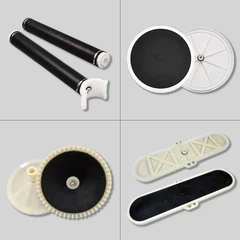
The full supply scope for this project comprised 6 equipment categories and 15+ individual technical specifications. All components were factory-fabricated and tested before shipment.
Fine Bubble Tube Diffuser - Φ90×1000 mm TPU Membrane
|
Parameter |
Specification |
|
|
Quantity |
1,496 units |
|
|
Membrane material |
Imported TPU (thermoplastic polyurethane) |
|
|
Dimensions |
Φ90 × 1,000 mm |
|
|
Micro-pore count |
≥ 25,000 pores per unit |
|
|
Air flow range (per unit) |
7.5 – 14 m³/h (design range: 6 – 18 m³/h) |
|
|
Membrane thickness |
0.70 ± 0.05 mm |
|
|
Inner liner |
PP or ABS/UPVC (1.0 MPa rated) |
|
|
Bubble diameter |
1 – 2 mm |
|
|
SOTE @ 8.2 m water depth (clean water) |
≥ 35% |
|
|
SAE (Standard Aeration Efficiency) |
≥ 7.5 kgO₂/kW·h |
|
|
SOTR (per unit) |
≥ 0.85 kgO₂/h |
|
|
Resistance loss |
≤ 5,500 Pa |
|
|
3-year membrane degradation rate |
≤ 8% |


> SOTE and SAE values measured under clean water conditions at 8.2 m submergence depth, aligned with EN 12255-15 oxygen transfer measurement protocols.
SS304 Retrievable Aeration Framework
|
Component |
Specification |
Quantity |
Material |
|
Riser pipe |
D159 × 3.4 mm |
176 m total |
SS304 |
|
Retrievable frame group (air distribution header assembly) |
Main pipe D159×3.4mm + branch pipe D110×3.0mm |
22 groups |
SS304 |
|
Condensate drain + manual drain valve |
DN20 |
22 sets |
SS304 |
|
Pipe clamps |
To match all pipe sizes |
Full complement |
SS304 |
Supporting Equipment
|
Item |
Description |
Quantity |
|
Mobile acid-wash unit |
Acid wash cart + dosing pump |
1 set |
!AquaSust SS304 retrievable aeration frame groups prior to installation in oxidation ditch
*Alt: SS304 retrievable aeration frame installation - 22 groups Φ90 tube diffuser oxidation ditch case*
Engineering Design Basis
Dual-Blower Duty Point Design
The system was engineered for two distinct operating conditions to match the phased commissioning strategy:
|
Parameter |
Single-Blower Duty |
Dual-Blower Duty |
|
Total airflow |
12,000 m³/h |
24,000 m³/h |
|
Diffuser count |
1,496 units |
1,496 units |
|
Airflow per unit (calculated) |
~8 m³/h |
~16 m³/h |
|
Design airflow range |
6 – 18 m³/h |
6 – 18 m³/h |
Both duty points fall within the rated air flow range of the Φ90-1000 tube diffuser (7.5 – 14 m³/h nominal; 6 – 18 m³/h design envelope), confirming continuous operation without over-pressuring membranes at peak blower capacity.
Diffuser Coverage Geometry
Each of the 1,496 diffuser units was assigned a minimum individual service area of ≥ 1.75 m² within the oxidation ditch footprint. This coverage density was calculated to deliver uniform dissolved oxygen distribution across the aeration zone cross-section, avoiding preferential flow channels that would reduce nitrification efficiency at high flow rates.
- Tank water depth: 7.15 m
- Diffuser installation height above tank floor: 0.40 m
- Effective submergence: 6.75 m (operating water column above diffuser face)

Why Fully Retrievable in an Oxidation Ditch?
Oxidation ditches present a specific engineering challenge: submersible mixers (channel flow propellers) must maintain unobstructed sweep paths through the aeration zone. A fixed bottom-mounted diffuser grid creates a permanent interference with mixer servicing and replacement.
The fully retrievable frame design resolves this conflict structurally. Each of the 22 frame groups lifts vertically as a complete unit. Mixer access, inspection, or replacement can proceed with the aeration assembly removed - without draining the channel, without disturbing the sludge bed, and without process shutdown. This spatial compatibility between aeration and mixing equipment was a primary engineering rationale for the fully retrievable specification on this project.
Φ90 TPU tube diffuser installation completed view inside oxidation ditch - 1496 units AquaSust
Installation & Commissioning Timeline
The entire project from factory departure to installation completion was executed in Q1 2026, spanning approximately 22 days of on-site work.
Milestone Sequence
|
Milestone |
Period |
Activity |
|
Factory despatch |
Early Q1 2026 |
Factory acceptance, packaging, and shipment |
|
Frame & pipework delivery |
Week 1, Q1 2026 |
SS304 retrievable frames, riser pipes, condensate drain assemblies arrive on site; unboxing inspection completed by client and supervisor representatives |
|
Tube diffuser delivery |
Week 2, Q1 2026 |
1,496 Φ90×1000 TPU tube diffuser units arrive on site; unboxing inspection completed |
|
Installation complete |
Day 22, Q1 2026 |
All 22 frame groups installed; all 1,496 diffusers mounted and air-supply connections completed |
Commissioning Scope
On-site commissioning activities performed by the AquaSust engineering team included:
- Air pressure leak test: Full-system pneumatic pressure test at operating pressure across all 22 frame groups and 1,496 diffuser connections
- DO verification: Dissolved oxygen measurement at multiple tank positions to confirm uniform distribution under single-blower and dual-blower duty conditions
- Effluent quality test: Biological treatment effluent water quality sampling and analysis against design discharge parameters
- Integrated commissioning: Coordinated blower-to-diffuser airflow sequencing, condensate drain function test, and mixer clearance confirmation
- Multi-party acceptance: On-site inspection and sign-off by client representative and resident supervisor
No tank drainage was required at any stage of installation or commissioning. The oxidation ditch remained in biological operation throughout the installation phase via planned aeration zone isolation.
Post-Commissioning Verification - 4-Month Operational Result
The most rigorous validation in this project came not at installation, but 4 months into continuous operation.
Five-Party Joint Inspection
Following standard regulatory practice for municipal infrastructure works, a formal joint inspection was convened with five responsible parties present:
1. The plant operator (client)
2. The construction supervisor / resident engineer
3. The design consultant
4. The independent inspection authority
5. AquaSust engineering team
The inspection format included a live lift test : selected frame groups were physically raised from the operational tank to the surface - with the oxidation ditch in live biological operation - to allow expert panel inspection of:
- Membrane integrity (no tears, deformation, or surface fouling exceeding design tolerance)
- Diffuser orifice condition (no blockage or abnormal clogging pattern)
- SS304 frame structural condition (no corrosion, deformation, or fastener failure)
- Air distribution pipe connections (no leakage or joint deterioration)
Result: All inspection criteria met. Expert panel confirmed full qualification with zero deficiencies recorded.
This live retrieval test - conducted under real operating conditions after 4 months of continuous service - is the definitive engineering demonstration that a fully retrievable aeration system delivers on its core design premise: accessible, non-disruptive maintenance without process interruption.
Post-commissioning lift verification - retrievable aeration frame raised from live oxidation ditch
*Alt: aeration system 4-month post-commissioning verification - SS304 retrievable aeration frame lift test*
Why Fully Retrievable Aeration for Municipal WWTP?
This project validates three strategic values of the fully retrievable aeration system specification for municipal wastewater treatment:
Zero Downtime for Future Maintenance
The live lift test conducted at the 4-month inspection confirmed that the entire aeration assembly can be raised from an operating tank without process shutdown. For future membrane cleaning, diffuser replacement, or structural inspection cycles, maintenance events are measured in hours - not the 10–15 days typical of tank-drainage-dependent bottom-mounted systems (industry benchmark, consistent with WEF MOP 8 operational data for comparable municipal facilities).
Eliminate Tank Dredging and Drainage Cost
Each tank drainage event for a conventional bottom-mounted system requires mechanical dewatering, settled sludge removal, confined-space entry compliance, and post-maintenance biological process re-stabilization. For a deep oxidation ditch at 7.15 m water depth, these costs are amplified by the volume involved. The fully retrievable system eliminates this cost category entirely for diffuser-related maintenance events across the system's operational life.
Long-Term OPEX Reduction
The combination of zero-drainage maintenance and the specified membrane degradation ceiling (≤ 8% over 3 years) creates a predictable, low-variance operational cost profile. Operators can schedule planned maintenance events without regulatory compliance risk, biological process disruption, or emergency budget exposure. The SAE specification of ≥ 7.5 kgO₂/kW·h ensures that the system maintains energy efficiency within design parameters across the warranty period.
FAQ
Q: What is a fully retrievable aeration system?
A: A fully retrievable aeration system integrates all components - air distribution main pipes, branch pipes, diffuser mounts, and membrane tube diffusers - into a unified structural frame per aeration zone group. The entire assembly is engineered for crane-assisted vertical extraction from the tank as a single unit, without sub-component disassembly and without tank drainage. In this project, 22 such frame groups - each carrying a bank of Φ90×1000 TPU tube diffusers - were installed in a 7.15 m deep oxidation ditch, then successfully extracted and re-submerged during a live operational inspection after 4 months of service. Explore the AquaSust tube diffuser series for current product specifications.
Q: How long does installation take for a 1,500-unit tube diffuser system?
A: For this 4th-phase municipal WWTP expansion, the AquaSust engineering team completed full installation of 1,496 Φ90×1000 TPU tube diffusers and 22 SS304 retrievable frame groups within 22 days from first site delivery to installation sign-off. This timeline included unboxing inspection, frame assembly, diffuser mounting, air-supply piping connections, full pneumatic pressure testing, DO verification, and coordinated multi-party acceptance. Site-specific factors - tank geometry, crane access, blower room configuration - will influence timelines for other projects; AquaSust engineering will provide a project-specific schedule at quotation stage.
Q: What is the difference between SOTE at 8.2 m vs 6 m water depth?
A: Standard Oxygen Transfer Efficiency (SOTE) increases with submergence depth because a deeper water column provides a longer bubble contact path and greater hydrostatic pressure, both of which increase oxygen dissolution rate. The Φ90×1000 TPU tube diffusers supplied for this project are rated at SOTE ≥ 35% at 8.2 m water depth (clean water test). At a more common basin depth of 6 m, SOTE values for comparable tube diffusers typically fall in the 28–32% range (industry benchmark, consistent with EPA/625/1-89/023 submergence correction factors). Specifying a deeper aeration basin - as in this project at 7.15 m effective depth - therefore delivers a meaningful improvement in oxygen transfer per unit of air energy input without changing diffuser type or blower specification.
Q: Why choose TPU fine bubble tube diffuser membrane over EPDM?
A: TPU (thermoplastic polyurethane) membranes offer a combination of mechanical flexibility and chemical resistance that is well-suited to continuous municipal aeration duty. In this project, the TPU membrane specification was selected for its dimensional stability under cyclical pressure loading and its documented low fouling susceptibility relative to conventional EPDM membranes under comparable operating conditions (industry benchmark). The membrane degradation ceiling of ≤ 8% over 3 years specified for this project is the contractual performance anchor for the 3-year system warranty and the 5-year membrane warranty. EPDM membranes remain a valid alternative for standard-depth installations; for comparison of disc diffuser configurations with EPDM membranes, see the disc diffuser alternative page.
Q: Can retrievable aeration be installed in an oxidation ditch with mixers?
A: Yes - and this is precisely the configuration deployed in this project. The key engineering requirement is maintaining adequate horizontal clearance between the retrievable frame footprint and the mixer sweep path. In this oxidation ditch, the 22 retrievable frame groups were positioned to ensure safe operational distance from the submersible channel-flow mixers in all operational configurations. The vertical extraction path of each frame group was also confirmed to clear the mixer mounting hardware during the lift sequence. This coordination is resolved during the design phase; AquaSust engineering team performs clearance verification as part of project-specific drawing review before fabrication. Review the SS304 retrievable aeration components for structural specifications.
Conclusion
This 4th-phase municipal WWTP expansion in East Asia demonstrates that a fully retrievable tube diffuser installation - when correctly specified, fabricated, and commissioned - delivers verifiable performance under real operational conditions. Key confirmed outcomes:
- 1,496 Φ90×1000 TPU tube diffusers and 22 SS304 retrievable frame groups installed in 22 days with no tank drainage required
- SOTE ≥ 35% at 8.2 m water depth, SAE ≥ 7.5 kgO₂/kW·h confirmed within design parameters
- Five-party joint inspection after 4 months of continuous service: all criteria met, zero deficiencies recorded
- Live lift test confirmed functional retrievability under operational conditions - the defining proof point for this system type
For municipal WWTP operators planning new construction or capacity expansion, the engineering case for fully retrievable aeration is grounded in lifecycle cost, not just capital cost. The ability to service 1,496 diffusers without draining a 7.15 m deep oxidation ditch - confirmed in this project after months of real service - is the operational advantage that bottom-mounted alternatives cannot replicate.
Ready to evaluate a fully retrievable aeration system for your project?
Explore the AquaSust tube diffuser series for full technical specifications and configuration options. Review SS304 retrievable aeration components for material and structural details. For disc-based aeration alternatives, see the disc diffuser alternative page. Visit the aeration diffuser overview for a full range comparison.
To request a project-specific engineering consultation or quotation, contact the AquaSust
Engineering Team directly at aquasustfactory.com.