

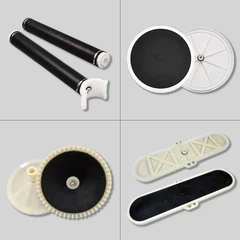


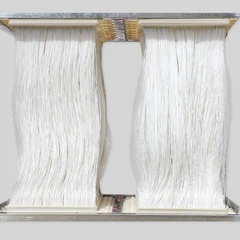


The basic design idea of the MBBR is to be able to operate continuously, without clogging, without backwashing, with low head loss and a large specific surface area. This can be achieved by the biofilm growing on smaller carrier units, which move freely with the water flow in the reactor. In aerobic reactors, the carrier is moved by aeration, and in anoxic/anaerobic reactors, the carrier is moved by mechanical agitation. To prevent the loss of packing material in the reactor, a porous filter can be set up at the outlet of the reactor (Fig. 1). MBBRs are generally rectangular or cylindrical in shape. The rectangular reactor is evenly divided into several or no compartments with partitions along the length of the tank. In general, the water flow is in a push-flow state in the reactor, while in each cell, the water flow is completely mixed due to aeration fluidization. The tank is filled with polyethylene or polypropylene suspension packing with a specific gravity close to water and a large specific surface area, and the biofilm attachment surface in the reactor can reach 500 m2/m3, and the actual specific surface area (inner surface of the filler) is 350 m2/m3. The perforated aeration tube is aerated on one side to circulate the packing through the tank. The bottom of the cylindrical reactor is equipped with a microporous aeration head. In addition, some reactors are not only equipped with an aeration device at the bottom of the tank, but also a stirring device. These stirring devices allow the reactor to be easily and flexibly used in anoxic conditions. Sometimes in order to prevent the air stripping and volatilization caused by aeration, a lid can be added above the reactor.
In foreign countries, MBBR has been used to carry out small-scale, pilot-scale and productive studies on the treatment of domestic sewage and some industrial wastewater, and good results have been obtained. The test results show that the moving bed biofilm wastewater treatment process is suitable for the treatment of medium and small domestic sewage and industrial organic wastewater. Among them, integrated or buried sewage treatment devices have a good prospect for promotion and application in China. However, there are still some problems with moving bed biofilm reactors, such as uneven movement of the packing material in the reactor and varying degrees of dead zones in the tank. How to improve the hydraulic flow characteristics in the reactor and reduce the operating energy consumption is a problem worthy of in-depth discussion in the development of moving bed biofilm reactors. The operation of MBBR in the same way as SBR is an improvement of MBBR technology, which is called Moving.Bed Sequencing BatchBiofilm Reactor (MBSBBR), which has the advantages of both MBBR and SBR. Another improvement is to circulate the packing material with the water flow in the reactor, which is called the cyclic mobile carrier biofilm reactor, which has the advantages of both MBBR and internal circulation reactors.