

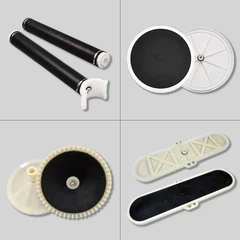


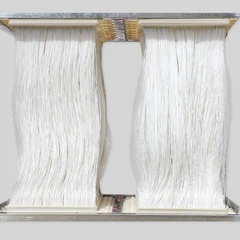


To select the correct moving bio bed media for your wastewater applications, you'll want to consider a few different factors:
Media Surface Area
Adequate surface area is necessary to facilitate microorganism growth. Media surface area sometimes correlates with biodegradation rates, but other factors can affect biodegradation as well, so the correlation is not a perfect one.
In general, a wastewater treatment plant should maximize media surface area while still making sure the media carriers meet the facility's needs in their other characteristics. MBBR media carriers in the shape of spoked wheels, for example, offer a tremendous surface area for their size to help a plant meet its waste digestion needs.
Performance and Required Biodegradation Rates
Optimal performance and biodegradation rates are critical for helping a plant move wastewater through secondary treatment quickly and efficiently. Performance and biodegradation rates often rise with increased media surface area. They also depend on factors like influent and effluent characteristics, fluctuations in the wastewater pollutant concentrations, the tank's minimum temperature, and the biological metabolisms of the tank's microorganisms.
In general, to optimize performance and biodegradation rates, plants should seek out MBBR media carriers of the correct shape and material quality to provide efficient, effective waste digestion.
Design and Shape
As we've discussed above, the design and shape of MBBR bio media carriers help determine waste breakdown efficiency and effectiveness. Media carriers with intricate, cut-out shapes tend to offer more surface area per media weight to enhance bacterial growth and promote biosolid breakdown.
The MBBR media carriers' design should also give them a density close to the wastewater density. The right density promotes even dispersal throughout the tank and ensures thorough waste digestion. Different materials offer different densities - the more economical re-granulates, for instance, may have substantial fluctuations in density between carrier pieces, whereas polyethylene may provide more consistency.
Wear Resistance
The wear-resistant characteristics of MBBR media carriers determine how they hold up to the demands of wastewater treatment. More resistant media carriers last longer and require fewer changes over time. Some MBBR media carriers, such as sponge-types, have limited resistance to abrasion, so they wear out more easily. Chip-type carriers tend to offer better resistance and a longer life span. Tube-shaped versions may suffer wear because the insides of the tubes tend to accumulate biomatter, which then dies and inhibits active waste digestion.
Maintenance
MBBR media systems require relatively little maintenance. Some materials like polyethylene last longer than others and minimize maintenance needs, so facility managers will want to look into different materials and determine what life span the plant requires for its media.
MBBR MEDIA CALCULATION
How is MBBR media volume calculated? To calculate the number of media carriers a facility may need for a wastewater tank, it should first determine the organic load of its wastewater. The organic load will be more or less equal to the product of the flow rate and the difference between the influent and effluent concentration.
Organic load = flow rate x (influent concentration – effluent concentration)
Once a facility has determined its flow rate, it can then calculate the necessary media supply. Generally, the carrier amount is equal to the wastewater's organic load divided by the media's removal efficiency.
Carrier amount = organic load / removal efficiency
Below, we use the product MBBR19 as an example to calculate the required amount of fill for the biofilm reactor.
Product Parameters for MBBR19:

Size: Φ25*12mm
Hole Numbers: 19
Material: 100% White Virgin HDPE
Density: 0.96-0.98g/cm3
Surface Area: >650m2/m3
BOD5 load/SA: 2-16g BOD5/m2.dy
Porosity: >85%
Dosing Ratio: 15-65%
Membrane-Forming Time: 3-15days
Nitrification Efficiency: 400-1200gNH4 N/M3.d
BOD5 Efficiency: 2000-10000g BOD5/M3.d
COD5 Efficiency: 2000-15000 gCOD5/M3.d
Applicable Temperature: 5-60℃
Life-Span: >15 years
Wastewater Treatment Parameters:
|
Parameter Value |
Value |
|
Inlet BOD Concentration |
100 mg/l |
|
Outlet BOD Concentration |
20 mg/l |
|
Flow Rate |
1000 m3/d |
|
BOD Load |
80 kg BOD/d |
Calculation using Biofilm Surface Area:
Given Surface Area: >650m2/m3, taken as 650m2/m3
BOD5 load/SA: 2-16g BOD5/m2.d, taken as 9kgBOD5/M3.d
Determine total biofilm surface area required for BOD removal:
Total surface area required for biofilm = 80000g BOD5/day / 9g BOD5/m2.d = 8888.89m2
Calculate volume of fill required:
Volume of fill required = 8888.88 m² / 650 m²/m³ = 13.67m³
Calculation using BOD5 Efficiency:
Using biofilm treatment efficiency: 2000-10000g BOD5/M3.d, taken as 6kgBOD5/M3.d
Total surface area required for biofilm = 80 kg BOD5/day / 6 kg BOD5/M3.d = 13.33m3
The above is a rough calculation for the MBBR fill, provided for reference only. The amount of fill required needs to be determined by engineers or facility managers considering the removal efficiency of different fills and inputting these values into the formula to determine the necessary fill carrier volume.
How to calculate the required quantity of MBBR media in tank?
Convert the required media volume to weight (optional) If necessary, convert the required media volume to weight by multiplying it by the density of the MBBR media. Below are the weight parameters of Aquasust's MBBR media.
Required Media Weight = Required Media Volume * Density
Consider other factors Take into account any additional factors that may affect the weight of the media, such as irregular tank shape, hydraulic retention time, specific design requirements, or safety factors. In these cases, Aquasust has extensive experience in MBBR biofilm reactor schemes and is your best choice for water treatment engineering.
MBBR Filling Rate Calculation
The filling rate of MBBR (Moving Bed Biofilm Reactor) is determined by the volume of the biofilm reactor and the volume of MBBR used. The filling rate is calculated as the volume of MBBR media divided by the volume of the biofilm reactor. The filling rate can affect the fluidization of the MBBR tank. If the filling rate is too high, uneven distribution of media may occur under normal aeration or agitation intensity, leading to media accumulation and blockage.
For most wastewater treatment projects, the filling rate of MBBR is between 30-35%. Under normal aeration and agitation intensity, the fluidization state and treatment efficiency of MBBR biofilm reactors are optimal within this range.
In a small-scale MBBR denitrification reactor, using carriers with 20%, 30%, 40%, and 50% polyethylene (PE) content respectively, degradation of chemical oxygen demand (COD) and nitrogen in wastewater effluent was studied under a hydraulic retention time (HRT) of 12 hours. The nitrate removal rates for carriers with 20%, 30%, 40%, and 50% PE were 94.2±3.8%, 87.6±7.4%, 89.7±11.6%, and 94.6±4.0%, respectively.
When treating wastewater with high concentrations, a higher filling rate is required. For example, in the treatment of wastewater from dyeing and paper mills, the filling rate of MBBR is generally not less than 45%. The maximum verified filling rate is currently 67%. In aerobic zones, the maximum achievable filling rate is 60%, and in anoxic zones, it is 50%.
Please note that precise calculations may vary based on the specific requirements and design considerations of each aerobic tank system. It is recommended to consult with Aquasust's wastewater treatment engineers or experts to ensure accurate calculations and optimal media selection for your specific application.