





Product Parameters
Sludge Treatment Capacity
|
Type |
DS Standard Processing Volume |
Theoretical Reference For Sludge Treatment Volume (specific treatment volume is determined by the flocculation effect of sludge and chemicals) |
|||||||
|
Low concentration→High concentration |
2000mg/L |
5000mg/L |
10000mg/L |
20000mg/L |
25000mg/L |
50000mg/L |
|||
|
Sludge Treatment Capactiy |
kg/h |
kg/h |
m³/h |
m³/h |
m³/h |
m³/h |
m³/h |
m³/h |
|
|
AS-NH-352 |
~120 |
~200 |
~60 |
~24 |
~20 |
~10 |
~8 |
~4 |
|
|
AS-NH-353 |
~180 |
~300 |
~90 |
~36 |
~30 |
~15 |
~12 |
~6 |
|
|
AS-NH-401 |
~90 |
~150 |
~45 |
~18 |
~15 |
~7.5 |
~6 |
~3 |
|
|
AS-NH-402 |
~180 |
~300 |
~90 |
~36 |
~30 |
~15 |
~12 |
~6 |
|
|
A S -N H-403 |
~270 |
~450 |
~135 |
~54 |
~45 |
~22.5 |
~18 |
~9 |
|
|
AS-NH-404 |
~360 |
~600 |
~180 |
~72 |
~60 |
~30 |
~24 |
~12 |
|
|
AS-NH-404/SC |
~360 |
~600 |
~180 |
~72 |
~60 |
~30 |
~24 |
~12 |
|
Mechanical Specifications & Dimensions
|
Model |
Spiral Shaft Specifications |
Mechanical Size |
Net weight |
Operating weight |
||
|
Length (Variable) |
Width (variable) |
Height (Variable) |
||||
|
mm*pcs |
mm |
mm |
mm |
kg |
kg |
|
|
AS-NH-401 |
400*1 |
3800 |
1100 |
2100 |
1085 |
2400 |
|
AS-NH-402 |
400*2 |
4100 |
1500 |
2050 |
2200 |
4200 |
|
AS-NH-403 |
400*3 |
4370 |
1800 |
2150 |
3300 |
6300 |
|
AS-NH-404 |
400*4 |
4800 |
2600 |
2050 |
4500 |
7200 |
Key Advantages of AquaSust High Capacity Sludge Dewatering Machine
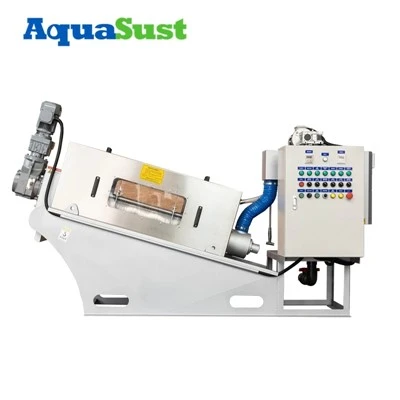
AquaSust high capacity sludge dewatering machines are configured for higher sludge loads, combining high solids throughput with continuous screw press dewatering for larger wastewater treatment systems.
High Dry Solids Throughput
The high-capacity range covers approximately 120–600 kg DS/h, providing higher solids-handling capacity for wastewater treatment facilities with substantial sludge production.
01
Multi-Shaft Configurations
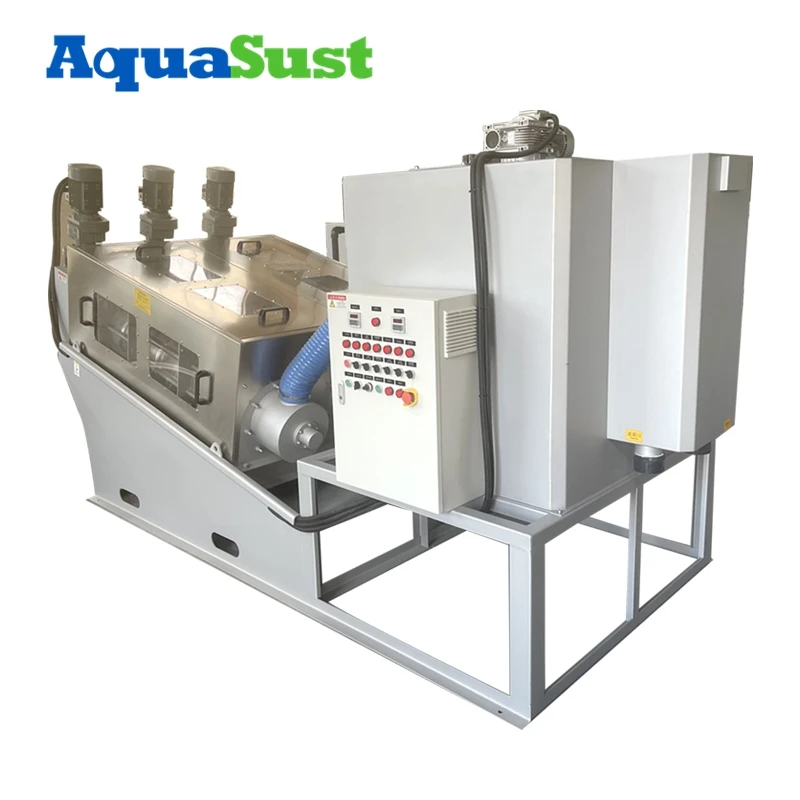
Multiple models use multi-shaft screw press configurations to provide higher processing capacity. This configuration enables the high-capacity range to handle substantially greater solids loads than the smaller equipment series.
02
Continuous High-Load Dewatering
The screw press continuously conveys, thickens, dewaters, and discharges sludge, supporting regular operation under higher sludge loads. This continuous process helps maintain a consistent mechanical dewatering workflow.
03
Broad Model Capacity Range
The high-capacity range includes AS-NH-352, AS-NH-353, AS-NH-401, AS-NH-402, AS-NH-403, AS-NH-404, and AS-NH-404/SC, covering multiple capacity levels from approximately 120 to 600 kg DS/h.
04
Integrated Screw Press Components
The machine incorporates a screw shaft with a cobalt alloy wear layer, SS304 spray pipe and nozzles, a stainless steel protective cover with PMMA viewing windows, and a Schneider Electric control cabinet. These components provide the core conveying, wear protection, cleaning, equipment protection, observation, and electrical control functions of the dewatering system.
05


Common Applications of AquaSust High Capacity Sludge Dewatering Machine
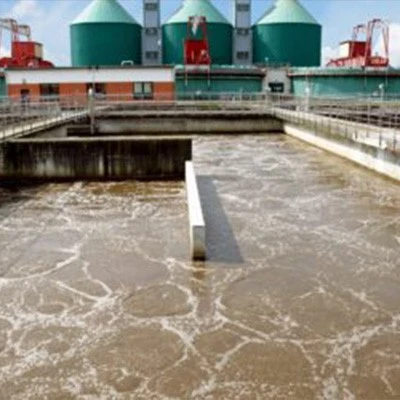
AquaSust high capacity sludge dewatering machines are intended for wastewater treatment systems with higher sludge production, supporting continuous dewatering in large municipal, industrial, and centralized sludge handling facilities.
|
|
|
Not Sure Which Sludge Dewatering Machine Fits Your Project?
AquaSust provides small, medium, and high capacity sludge dewatering machines to cover different sludge loads and treatment requirements, with multiple models available for different wastewater treatment conditions and processing capacities.
AquaSust Quality Control Throughout the Production Process
AquaSust maintains quality control throughout production to ensure each sludge dewatering machine meets the specified manufacturing and assembly requirements.
- Raw Material Verification - Incoming stainless steel and other major materials are checked against specified material grades, dimensions, surface condition, and supplier documentation before fabrication.
- Component & Dimensional Inspection - Key components such as the screw shaft, dewatering sections, spray system, covers, frames, and connection points are checked for dimensions, fit, and visible manufacturing defects.
- Welding & Fabrication Inspection - Welded structures and stainless steel components are inspected for weld appearance, continuity, deformation, and fabrication defects.
- Mechanical Assembly Inspection - The screw shaft, drive system, dewatering assembly, spray components, and other connected parts are inspected during assembly to verify alignment, fastening, clearance, and mechanical operation.
- Electrical & Control System Inspection - Motors, control cabinets, electrical connections, sensors, and operating controls are checked during assembly to verify correct connection and functional response.
- Finished Machine Inspection - Each completed sludge dewatering machine undergoes a final inspection covering overall dimensions, appearance, component installation, protective covers, connections, and operating condition before packaging and delivery.
AquaSust Supports You Throughout the Sludge Dewatering Project
AquaSust provides documentation, order coordination, and after-sales support for sludge dewatering equipment projects.
Technical Information & Documentation
AquaSust provides technical and product documentation for equipment evaluation, operation, and maintenance.
Support includes:
- Product catalogues and technical specifications
- Operating and maintenance manuals
- Installation guidance and video resources
- Product documentation for project use
Order & Delivery Support
AquaSust supports customers with order coordination and delivery-related arrangements throughout the purchasing process.
Support includes:
- Order tracking
- Packaging customization
- Delivery coordination
- Order status communication
Warranty & After-Sales Support
AquaSust provides a 1-year warranty for sludge dewatering machines according to its warranty policy.
Support includes:
- 1-year sludge dewatering machine warranty
- Warranty-related technical support
- Troubleshooting support
- Operation and maintenance guidance
FAQ
Q: How is the actual sludge treatment capacity determined?
A: The actual capacity depends on sludge concentration, sludge characteristics, and the flocculation effect of the sludge and chemicals. The listed values at different concentrations are theoretical reference figures for model selection.
Q: How should I choose between single- and multi-shaft models?
A: The choice should be based on the required dry solids throughput and the available installation conditions. AquaSust provides multiple shaft configurations across the high-capacity range to accommodate different sludge loads.
Q: Can the machine handle different sludge concentrations?
A: Yes. The high-capacity range provides reference treatment volumes at sludge concentrations from 2,000 to 50,000 mg/L. Actual performance should be confirmed according to the specific sludge conditions.
Q: What should be considered when integrating the machine into an existing treatment system?
A: Buyers should consider the upstream sludge conditioning process, feeding arrangement, cake discharge route, drainage, electrical connections, and available maintenance space when planning system integration.
Q: Does the machine require additional equipment for sludge conditioning?
A: The dewatering machine performs mechanical thickening and dewatering, while sludge conditioning requirements depend on the sludge characteristics and flocculation effect. The specific configuration should therefore be determined according to the project conditions.
Q: What information should I provide for high-capacity model selection?
A: Provide the sludge type, sludge concentration, expected sludge production, required dry solids capacity, and available installation conditions. These details allow AquaSust to recommend a suitable model and configuration.