





Introduction
For large wastewater aeration tanks, choosing between disc diffusers and strip diffusers affects more than how air enters the water. The diffuser configuration determines how the tank floor can be utilized, how the air distribution grid is arranged, and how easily the system can be installed, maintained, or upgraded. Disc diffusers use individually positioned circular membranes, while strip diffusers provide elongated aeration elements that can cover long sections of the basin. For buyers comparing these options, the key question is not which diffuser type is universally better, but which design fits the tank layout, required airflow, and operating budget with the least compromise.

What Are Disc Diffusers and Strip Diffusers?
Disc diffusers and strip diffusers both introduce air into wastewater through fine-bubble membranes, but their physical configurations lead to different installation and design considerations.
Disc Diffusers
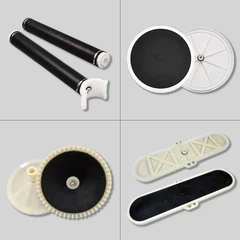
Disc diffusers consist of circular membranes mounted on individual bases and connected to an air distribution grid. Because each unit occupies a defined position, engineers can adjust the number, spacing, and placement of diffusers to suit the basin geometry and required aeration coverage.
- Flexible Diffuser Placement: Individual units can be positioned around floor obstructions, tank features, or designated aeration zones.
- Multiple Membrane Options: EPDM, PTFE, silicone, and TPU are available in selected configurations, allowing buyers to assess membrane suitability against wastewater chemistry and operating conditions.
- Replaceable Membranes: Where the design permits, individual membranes can be replaced without replacing the entire diffuser assembly.
- Fine-Bubble Performance Options: Available models can be evaluated by bubble size, recommended airflow, pressure loss, and oxygen transfer data to match the required operating range.

Strip Diffusers
Strip diffusers use elongated membrane elements installed in linear arrangements along the tank floor. Their slim profile makes them particularly relevant to rectangular basins where long, parallel diffuser runs can cover substantial floor areas.
- Continuous Linear Coverage: Individual strips can extend along defined sections of the basin, reducing the need to position numerous separate circular units.
- High Floor Occupancy: Slim-profile designs can achieve high diffuser occupancy in suitable layouts, making them worth evaluating when extensive floor coverage is required.
- Integrated System Components: A complete system may include strip diffusers, compatible piping, and fixing components to support installation planning.
- On-Site Membrane Replacement: Selected designs support membrane replacement on site, which can reduce the need to replace complete diffuser assemblies during maintenance.

Disc Diffuser vs Strip Diffuser: Key Differences
The following comparison focuses on the factors that can change a project's equipment selection, installation plan, and operating costs.
|
Comparison Factor |
Disc Diffuser |
Strip Diffuser |
|
Best-Fit Tank Layout |
Irregular layouts, divided aeration zones, or tanks requiring adjustable individual diffuser positions |
Rectangular basins with long, parallel aeration runs |
|
Floor Coverage |
Coverage is adjusted by changing unit quantity and spacing |
Slim-profile strips can provide high occupancy along continuous rows |
|
Air Distribution Design |
Requires the placement and connection of individual diffuser units |
Can simplify layout planning where the basin supports linear diffuser runs |
|
Airflow Configuration |
Must be checked against the selected model's recommended operating range |
Must be checked against the selected model's recommended operating range |
|
Oxygen Transfer |
Depends on membrane design, airflow, water depth, and diffuser spacing |
Depends on membrane design, airflow, water depth, and strip arrangement |
|
Pressure Loss and Energy |
Evaluate pressure-loss data alongside the blower operating point |
Evaluate pressure-loss data alongside the blower operating point |
|
Installation Considerations |
Individual placement and connections may require more layout work in large grids |
Linear installation may simplify work in suitable basin layouts |
|
Maintenance |
Individual units can be accessed according to the grid design; membrane replacement depends on the model |
Selected systems allow on-site membrane replacement; access depends on the mounting arrangement |
|
Initial Investment |
Influenced by diffuser quantity, piping, mounting, and installation labor |
Influenced by strip configuration, piping, mounting, and installation labor |
|
Main Selection Advantage |
Adaptable placement and membrane selection |
Continuous coverage and potentially lower installation costs in suitable layouts |
How to Choose Between Disc Diffusers and Strip Diffusers for Large Aeration Tanks
The right diffuser should match the tank layout, treatment requirements, operating conditions, and long-term maintenance needs.
Evaluate Tank Layout and Required Floor Coverage
For large rectangular basins with unobstructed floors and long, parallel diffuser rows, strip diffusers are a strong option to evaluate first. Their linear configuration can simplify layout planning when compatible piping and mounting arrangements are available. Disc diffusers are more adaptable to tanks with columns, channels, irregular sections, or separate aeration zones because individual units can be positioned around these constraints. For retrofits, compare both options with existing pipe locations and mounting arrangements.
Match the Required Airflow to the Diffuser Model
Start with process oxygen demand and required airflow rather than tank size or diffuser quantity alone. Compare each model's recommended airflow range, total unit count, operating depth, and pressure loss to determine whether it can meet the system's aeration requirements. Request oxygen transfer data measured under comparable conditions to assess performance accurately and avoid placing unnecessary demands on the blower system.
Consider Wastewater Conditions and Maintenance Access
Wastewater composition can affect membrane fouling, scaling, and service life. Assess chemical exposure, mineral deposits, cleaning needs, and access for component replacement. For disc diffusers, EPDM is commonly used for general aeration, while PTFE-coated or other specialized membranes may suit particular chemical-resistance or scaling-control requirements. Silicone and TPU are options for selected configurations, subject to compatibility with actual operating conditions. For strip diffusers, verify membrane compatibility, casing material, and replacement procedures. For both types, confirm how membranes can be inspected, cleaned, and replaced with minimal disruption.
Compare Total Installed and Operating Costs
Strip diffusers may reduce installation work when continuous runs and compatible piping simplify the layout. Disc diffusers may be more economical when flexible placement avoids costly modifications around obstructions or allows individual units to be replaced. Request itemized quotations covering diffusers, piping, mounting components, installation, and replacement parts. Also compare blower energy requirements using the proposed system's airflow and pressure-loss data. The lowest purchase price does not necessarily deliver the lowest lifetime cost; evaluate installation, energy, and maintenance expenses together.
Conclusion
For large aeration tanks, strip diffusers are a strong starting point for evaluation when the basin is rectangular, supports long parallel diffuser runs, and benefits from high floor occupancy or a streamlined installation layout. Disc diffusers are often the more adaptable option when individual placement, irregular tank geometry, or different membrane choices are important. Neither type should be selected on layout alone: model-specific airflow ranges, pressure loss, oxygen transfer data, wastewater conditions, and maintenance access must also be considered. AquaSust supplies fine bubble disc diffusers and strip diffusers for wastewater treatment applications, with configurations for different membrane and operating requirements. Contact us with your basin dimensions, water depth, oxygen demand, and available blower specifications to discuss which diffuser configuration is better suited to your project.