





Introduction
Fine bubble diffusers play an important role in wastewater treatment by transferring oxygen into water to support biological treatment processes. Their performance depends on factors such as bubble size, oxygen transfer efficiency, airflow requirements, membrane materials, and installation design. Selecting the right diffuser requires engineers to understand the differences between available designs and evaluate how each option matches the treatment process, tank layout, and long-term operating requirements.

What Are the Main Types of Fine Bubble Diffusers?
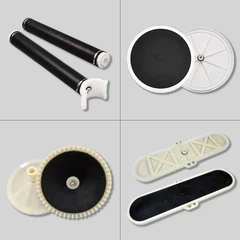
Fine bubble diffusers are available in several structural designs, each offering different installation options and aeration characteristics. Taking AquaSust fine bubble diffusers as an example, these differences can be seen across four common diffuser types.
|
Comparison Item |
||||
|
Images |
|
|
|
|
|
Basic Concept |
A circular elastic membrane clamped onto a disc-shaped support base |
A cylindrical elastic membrane mounted on a tubular body |
A flat rectangular aeration panel with a large perforated surface |
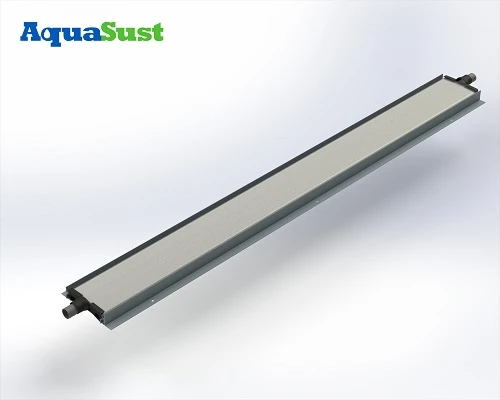
A long, slim diffuser element with a low-profile casing |
|
Working Principle |
Air passes through micro-pores on the disc membrane, forming fine bubbles that rise vertically |
Air is released through slit-shaped openings along the tube, distributing bubbles over the full length |
Air escapes through densely distributed holes across the plate, creating a broad, uniform bubble blanket |
Air is distributed continuously along the strip, producing uniform fine bubbles over long runs |
|
Bubble Size |
Typically 1–2 mm |
Typically 1–2 mm |
Typically 0.8–2 mm |
Typically 1–2 mm |
|
Membrane Materials |
EPDM, silicone, PTFE, TPU |
EPDM, silicone, PTFE, TPU |
EPDM, silicone |
TPU, EPDM |
|
Body / Casing Materials |
ABS, PP, or glass-fiber reinforced polymer |
ABS, PP, stainless steel (for retrievable systems) |
Plastic or composite frame |
PVC or stainless steel casing |
|
Typical Size Range |
200–350 mm disc diameter |
60–120 mm diameter; 0.5–1 m length |
Around 600 mm panel width |
Up to several meters continuous length |
|
Airflow Range (per unit) |
Low to moderate |
Moderate to high |
Moderate |
Moderate to high, wide control range |
|
Oxygen Transfer Efficiency |
High |
High |
High, aided by large surface area |
High, maintained over long runs |
|
Mixing Characteristics |
Localized vertical mixing |
Uniform along channel length |
Broad, gentle mixing over a wide area |
Uniform along the tank length |
|
Footprint & Layout |
Modular, flexible placement |
Linear arrangement along channels |
Large coverage per unit |
Very high occupancy density in rectangular basins |
|
Installation Style |
Modular, drop-in on pipe grids |
Mounted on headers, vertical or horizontal |
Fixed to tank floor |
Floor-mounted, elevated, or liftable |
|
Maintenance Consideration |
Individual membrane replacement |
Retrievable options allow lift-out without dewatering |
Plate cleaning or replacement |
Fast on-site membrane replacement; regular air flushing recommended |
|
Service Life (general) |
3–7 years depending on material and conditions |
5–10 years, longer with stainless steel frameworks |
3–7 years |
5–10 years with proper maintenance |
|
Typical Applications |
Municipal and industrial WWTPs, aquaculture, compact tanks |
Long channels, oxidation ditches, large basins, retrofit projects |
Wide shallow basins, aquaculture, applications needing large surface coverage |
Rectangular basins, large municipal plants, aeration retrofits |
|
Best Suited When... |
Flexible modular layout and precise aeration are required |
Uniform aeration along long flow paths is needed |
Broad surface coverage with gentle mixing is preferred |
Maximum occupancy density and long continuous runs are desired |


What Performance Factors Matter When Selecting Fine Bubble Diffusers?
Engineers should compare the technical characteristics that directly influence aeration performance, energy consumption, and service life. These factors help determine whether a diffuser can meet the treatment system's operating requirements.
Oxygen Transfer Efficiency and Bubble Size
Smaller bubbles generally provide a greater gas–liquid contact area relative to their volume, which can support oxygen transfer. However, actual oxygen transfer efficiency also depends on water depth, wastewater properties, airflow, and diffuser condition. Engineers should review performance data under relevant test conditions and consider the system's oxygen demand instead of selecting products based on bubble size alone.
Airflow Range and Pressure Loss
The operating airflow of a diffuser must match the aeration system's oxygen demand and blower capacity. Pressure loss is also important because the blower must overcome both diffuser resistance and hydrostatic pressure. Comparing these parameters helps engineers evaluate whether the selected configuration can deliver the required air supply without creating unnecessary energy demands. Both minimum and recommended operating airflow should be checked against the manufacturer's specifications.
Membrane Material and Chemical Compatibility
Membrane materials such as EPDM, PTFE, and silicone differ in chemical compatibility, mechanical properties, and operating suitability. Selection should account for wastewater composition, temperature, cleaning methods, and the potential for fouling or material deterioration. Engineers should verify the material specifications for the intended application rather than assume that one material is universally suitable for every wastewater treatment environment.
What Are the Benefits of Choosing the Right Fine Bubble Diffuser?
Matching the diffuser design and specifications to the treatment system can improve aeration performance and help control long-term operating requirements.
- More Effective Oxygen Delivery - Selecting a suitable diffuser configuration and operating airflow helps distribute air in line with the biological treatment process's oxygen demand.
- Better Control of Aeration Energy Costs - Matching diffuser pressure loss and airflow requirements to the blower system can help avoid unnecessary energy use while maintaining the required oxygen supply.
- More Suitable Tank Coverage - Choosing a structure that fits the basin geometry and installation layout helps engineers plan diffuser spacing and air distribution more effectively.
- Simplified Maintenance Planning - Considering membrane materials, installation access, and replacement requirements during selection helps maintenance teams plan servicing and reduce avoidable downtime.
- Lower Risk of Equipment Mismatch - Reviewing technical specifications against actual operating conditions helps reduce the likelihood of selecting diffusers that cannot meet airflow, pressure, or installation requirements.
Conclusion
Selecting the right fine bubble diffuser requires balancing oxygen transfer performance, airflow requirements, membrane compatibility, installation layout, and long-term maintenance needs. Disc, tube, plate, and strip diffusers offer different structural options, so engineers should compare their specifications against the wastewater treatment process and site conditions rather than relying on a single performance indicator. AquaSust provides these four types of fine bubble diffusers to support different aeration system configurations and project requirements. Contact us to discuss your application needs and find a suitable fine bubble diffuser for your wastewater treatment system.