





In the realm of automata theory, Deterministic Finite Automata (DFAs) stand as fundamental constructs, wielding significant influence across various computational and engineering domains. As a dedicated DFA supplier, I've witnessed firsthand the transformative power of these devices and the profound impact they have on modern technological landscapes. One of the most intriguing aspects of DFAs is their closure property under union, a concept that not only enriches our understanding of automata theory but also unlocks a multitude of practical applications. In this blog post, I'll delve into the intricacies of this closure property, exploring its theoretical underpinnings, real-world implications, and the role it plays in shaping the future of DFA technology.
Understanding Deterministic Finite Automata
Before we dive into the closure property under union, let's take a moment to review the basics of DFAs. A DFA is a mathematical model of a computing machine that consists of a finite set of states, a set of input symbols, a transition function that maps states and input symbols to new states, a start state, and a set of accept states. The machine reads an input string symbol by symbol, starting from the start state, and transitions from one state to another according to the transition function. If the machine ends up in an accept state after reading the entire input string, the string is said to be accepted by the DFA; otherwise, it is rejected.
DFAs are widely used in various fields, including computer science, electrical engineering, and linguistics, to solve problems related to pattern recognition, string processing, and language recognition. For example, in computer science, DFAs are used to implement lexical analyzers, which are responsible for breaking down source code into tokens. In electrical engineering, DFAs are used to design sequential circuits, which are essential components of digital systems.
The Closure Property of DFAs under Union
The closure property of DFAs under union states that if we have two DFAs, (M_1) and (M_2), that recognize languages (L_1) and (L_2) respectively, then there exists a third DFA, (M_3), that recognizes the union of (L_1) and (L_2), denoted as (L_1 \cup L_2). In other words, the class of languages recognized by DFAs is closed under the operation of union, meaning that the union of any two regular languages (languages recognized by DFAs) is also a regular language.
To construct the DFA (M_3) that recognizes (L_1 \cup L_2), we can use a technique called the "product construction." The basic idea behind this technique is to simulate the behavior of both (M_1) and (M_2) simultaneously. The states of (M_3) are pairs of states, where the first element of the pair is a state from (M_1) and the second element is a state from (M_2). The start state of (M_3) is the pair consisting of the start states of (M_1) and (M_2). The transition function of (M_3) is defined such that when it reads an input symbol, it updates both components of the state pair according to the transition functions of (M_1) and (M_2). Finally, a state in (M_3) is an accept state if either the first or the second component of the state pair is an accept state in (M_1) or (M_2) respectively.


Practical Implications of the Closure Property
The closure property of DFAs under union has several practical implications. One of the most significant implications is that it allows us to combine the functionality of two or more DFAs into a single DFA. This can be particularly useful in applications where we need to recognize multiple patterns or languages simultaneously. For example, in a network intrusion detection system, we may have separate DFAs for detecting different types of network attacks, such as SQL injection attacks and buffer overflow attacks. By using the closure property under union, we can construct a single DFA that can detect both types of attacks, thereby simplifying the design and implementation of the system.
Another practical implication of the closure property is that it provides a powerful tool for proving the regularity of languages. If we can show that a language can be expressed as the union of two or more regular languages, then we can conclude that the language is also regular. This can be particularly useful in theoretical computer science, where we often need to prove the regularity of languages to establish the decidability of certain problems.
The Role of DFAs in Aquaculture
As a DFA supplier, I've seen firsthand the diverse range of applications for DFAs, including in the field of aquaculture. Aquaculture, or fish farming, is a rapidly growing industry that plays a crucial role in meeting the global demand for seafood. One of the key challenges in aquaculture is maintaining optimal water quality, which is essential for the health and growth of fish.
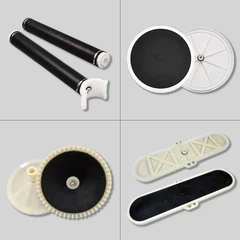
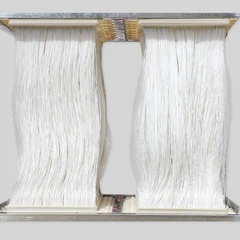
MBBR Media AS-MBBR04 For Aquaculture is a revolutionary product that uses DFA technology to monitor and control water quality in aquaculture systems. The product consists of a network of sensors that collect data on various water quality parameters, such as temperature, pH, and dissolved oxygen levels. This data is then processed by a DFA, which uses a set of pre-defined rules to determine whether the water quality is within the optimal range for fish growth. If the water quality falls outside the optimal range, the DFA can trigger an alarm or activate a control system to adjust the water quality parameters.
Contact for Procurement and Collaboration
If you're interested in learning more about our DFA products or have any questions about the closure property of DFAs under union, I'd be more than happy to help. Whether you're a researcher looking to explore the theoretical aspects of automata theory or a business owner in need of practical solutions for your industry, our team of experts is here to support you.
We offer a wide range of DFA products and services, including custom design and development, installation, and maintenance. Our products are designed to meet the highest standards of quality and reliability, and we're committed to providing our customers with the best possible value for their investment.
To learn more about our products and services or to discuss your specific requirements, please don't hesitate to contact us. We look forward to the opportunity to work with you and to help you achieve your goals.
References
- Hopcroft, John E., Rajeev Motwani, and Jeffrey D. Ullman. Introduction to Automata Theory, Languages, and Computation. Addison-Wesley, 2006.
- Sipser, Michael. Introduction to the Theory of Computation. Cengage Learning, 2012.