





Altitude is a critical environmental factor that can significantly influence the performance and operation of roots blowers. As a reputable roots blowers supplier, we have witnessed firsthand the various impacts of altitude on these essential pieces of equipment. In this blog, we will delve into the scientific aspects of how altitude affects roots blowers and discuss the implications for users and our business.
1. Understanding Roots Blowers
Before we explore the impact of altitude, it's essential to have a basic understanding of roots blowers. Roots blowers are positive displacement pumps that operate by two meshing lobes rotating in opposite directions within a housing. They are widely used in various industries, including wastewater treatment, pneumatic conveying, and aquaculture, to name a few. The main function of a roots blower is to deliver a constant volume of air or gas at a relatively low pressure.
2. The Role of Altitude in Air Density
One of the primary ways altitude affects roots blowers is through its impact on air density. As altitude increases, the atmospheric pressure decreases. According to the ideal gas law, (PV = nRT), where (P) is pressure, (V) is volume, (n) is the number of moles of gas, (R) is the ideal gas constant, and (T) is temperature. When the pressure (P) decreases with increasing altitude, assuming the temperature (T) remains relatively constant, the density of the air ((\rho=\frac{m}{V}), where (m) is mass) also decreases.
In practical terms, at higher altitudes, the air contains fewer air molecules per unit volume. This has a direct impact on the performance of roots blowers, as they rely on the intake of a specific volume of air to function effectively.
3. Impact on Blower Performance
3.1 Airflow and Capacity
The reduced air density at higher altitudes means that the roots blower takes in less mass of air per unit volume. Since the blower is designed to deliver a certain volume of air, the actual mass of air delivered decreases with increasing altitude. This reduction in the mass of air can lead to a decrease in the blower's capacity to perform tasks such as aeration in wastewater treatment or pneumatic conveying.

For example, in a wastewater treatment plant located at a high - altitude area, the roots blower may not be able to supply enough oxygen to the biological treatment process. This can result in poor treatment efficiency and potentially lead to non - compliance with environmental regulations.
3.2 Power Consumption
Another significant impact of altitude on roots blowers is related to power consumption. The power required to drive a roots blower is proportional to the mass flow rate of the air being delivered. As the air density decreases at higher altitudes, the mass flow rate decreases for a given volumetric flow rate. However, the blower still has to overcome the same internal and external resistances in the system.
In some cases, the blower may need to operate at a higher speed to maintain the required airflow. This can lead to an increase in power consumption, as the power required to drive the blower is also related to the speed of the blower. Additionally, the motor efficiency may be affected at higher altitudes due to the reduced cooling effect of the thinner air.
3.3 Pressure Ratio
The pressure ratio of a roots blower, which is the ratio of the discharge pressure to the intake pressure, can also be affected by altitude. At higher altitudes, the intake pressure is lower. To achieve the same discharge pressure as at sea - level, the blower has to work harder. This can put additional stress on the blower components, such as the lobes and bearings, and may lead to increased wear and tear.
4. Considerations for High - Altitude Applications
4.1 Blower Sizing
When selecting a roots blower for a high - altitude application, proper sizing is crucial. The blower needs to be sized to account for the reduced air density at the specific altitude of the installation. This may involve selecting a blower with a larger volumetric capacity than would be required at sea - level to ensure that the required mass of air is delivered.
4.2 Maintenance
Regular maintenance becomes even more important at high altitudes. The increased stress on the blower components due to the need to work harder to achieve the desired performance can lead to more frequent breakdowns. Maintenance tasks such as lubrication, inspection of the lobes, and checking the alignment of the blower should be carried out more frequently.
4.3 System Design
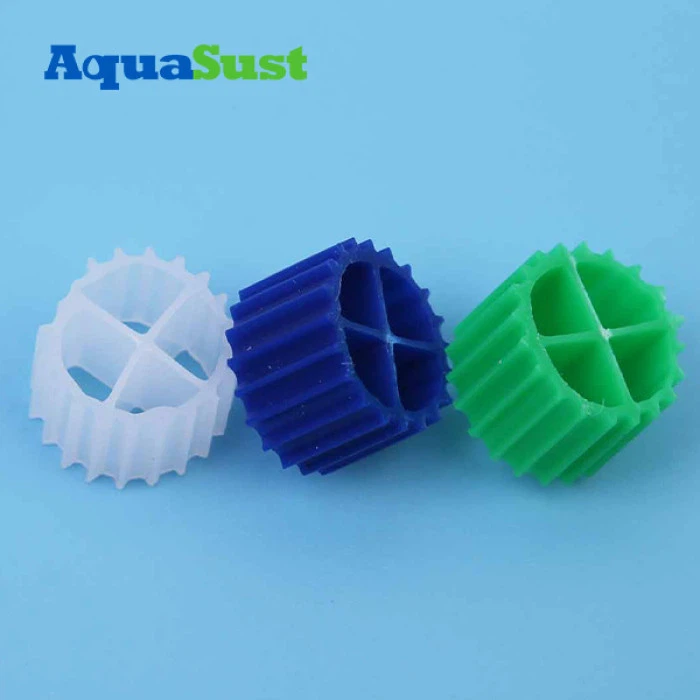
The overall system design also needs to be adjusted for high - altitude applications. For example, in an aquaculture system, the aeration requirements may need to be re - evaluated. Using media such as MBBR Media AS - MBBR04 For Aquaculture can help improve the efficiency of the system. These media provide a large surface area for the growth of beneficial bacteria, which can help in the biological treatment process. By optimizing the system design, the impact of altitude on the roots blower can be minimized.
5. Our Role as a Roots Blowers Supplier
As a roots blowers supplier, we understand the unique challenges faced by our customers in high - altitude areas. We offer a range of solutions to address these challenges.
5.1 Customized Blower Solutions
We have the expertise to design and manufacture roots blowers that are specifically tailored to high - altitude applications. Our engineers take into account the altitude, temperature, and other environmental factors when sizing and configuring the blowers. This ensures that our customers receive a blower that can perform effectively in their specific operating conditions.
5.2 Technical Support
We provide comprehensive technical support to our customers. Our team of experts can assist with the installation, commissioning, and maintenance of the roots blowers. We also offer training programs to help our customers' staff understand the impact of altitude on the blowers and how to operate and maintain them properly.
5.3 Product Innovation
We are constantly investing in research and development to improve the performance of our roots blowers, especially for high - altitude applications. Our goal is to develop blowers that are more efficient, reliable, and capable of withstanding the challenges posed by high altitudes.
6. Conclusion
Altitude has a significant impact on the performance and operation of roots blowers. The reduced air density at higher altitudes affects the airflow, power consumption, and pressure ratio of the blowers. However, with proper sizing, maintenance, and system design, these challenges can be overcome.
As a roots blowers supplier, we are committed to providing our customers with the best solutions for their high - altitude applications. If you are facing challenges with your roots blowers due to altitude or are planning a new installation in a high - altitude area, we encourage you to contact us for a consultation. Our team of experts will work with you to find the most suitable blower solution for your needs and help you optimize your system's performance.
References
- Perry, R. H., & Green, D. W. (1997). Perry's Chemical Engineers' Handbook. McGraw - Hill.
- ASHRAE Handbook. (2017). Fundamentals. American Society of Heating, Refrigerating and Air - Conditioning Engineers.