





What is the surface charge of MBBR media?
As a supplier of MBBR (Moving Bed Biofilm Reactor) media, I've received numerous inquiries about the surface charge of these media. Understanding the surface charge is crucial as it plays a significant role in the performance and efficiency of MBBR systems. In this blog, I'll delve into what the surface charge of MBBR media is, its importance, and how it impacts the overall functioning of the wastewater treatment process.
Understanding Surface Charge
Surface charge refers to the electrical charge present on the outer layer of a material. In the case of MBBR media, this charge can be either positive, negative, or neutral. The surface charge is determined by various factors, including the chemical composition of the media, the manufacturing process, and the environmental conditions in which the media is used.
Most commonly, MBBR media is made from polymers such as polyethylene or polypropylene. These materials inherently have a non - polar and relatively neutral surface. However, during the manufacturing process, specific additives or surface treatments can be applied to modify the surface charge. For example, some manufacturers use chemical agents to introduce functional groups on the media surface, which can result in a positive or negative charge.
Importance of Surface Charge in MBBR Systems
The surface charge of MBBR media has several important implications for the operation of MBBR systems:
Biofilm Attachment
One of the primary functions of MBBR media is to provide a surface for the attachment and growth of biofilms. Biofilms are complex communities of microorganisms that play a crucial role in the degradation of organic matter in wastewater. The surface charge of the media can significantly affect the initial attachment of microorganisms.
Microorganisms typically have a net negative charge on their cell surfaces. A positively charged MBBR media will attract these negatively charged microorganisms through electrostatic forces, facilitating better biofilm attachment. This initial attachment is the first step in the formation of a stable and efficient biofilm, which can enhance the treatment efficiency of the MBBR system.
Mass Transfer
The surface charge also influences the mass transfer of nutrients and pollutants between the bulk liquid and the biofilm. A charged surface can create an electrostatic field that affects the movement of ions and molecules. For instance, a positively charged surface can attract negatively charged ions, increasing their concentration near the biofilm surface. This can enhance the availability of nutrients for the microorganisms in the biofilm, promoting their growth and metabolic activity.
Resistance to Fouling
Fouling is a common problem in MBBR systems, where unwanted substances such as suspended solids, colloids, and organic matter can accumulate on the media surface, reducing its effectiveness. The surface charge can play a role in preventing fouling. A properly charged surface can repel certain types of foulants through electrostatic repulsion. For example, a negatively charged surface can repel negatively charged colloids, reducing their adhesion to the media surface.
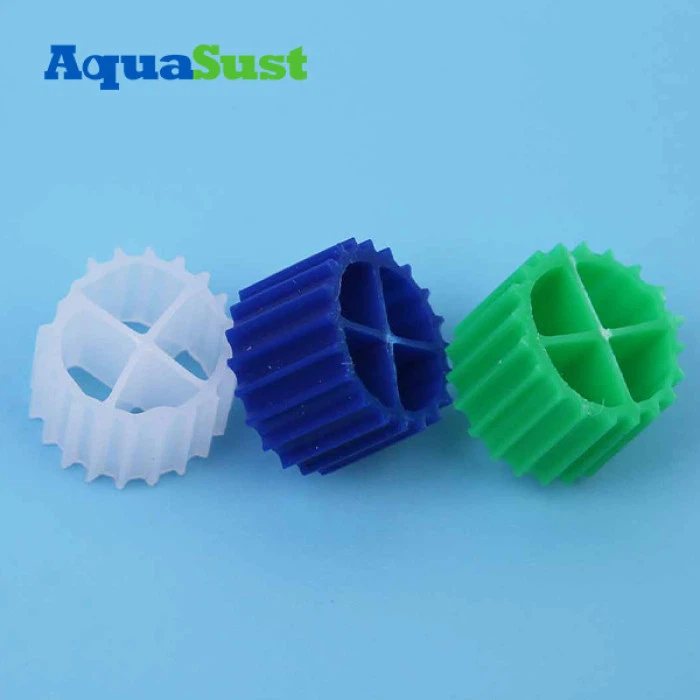
Our MBBR Media - AS - MBBR04 for Aquaculture
At our company, we offer a high - quality MBBR media called MBBR Media AS - MBBR04 For Aquaculture. This media is specifically designed for aquaculture applications, where the treatment of wastewater is crucial for maintaining a healthy environment for aquatic organisms.
Our AS - MBBR04 media has a carefully engineered surface charge that promotes excellent biofilm attachment and growth. Through advanced manufacturing techniques, we have optimized the surface charge to attract a diverse range of beneficial microorganisms, which can effectively remove ammonia, nitrite, and other harmful substances from aquaculture wastewater.
The surface charge of our AS - MBBR04 media also helps in reducing fouling, ensuring long - term and stable operation of the MBBR system. This is particularly important in aquaculture, where any disruption in the wastewater treatment process can have a significant impact on the health and growth of the aquatic organisms.
Measuring and Controlling Surface Charge
Measuring the surface charge of MBBR media is an important step in quality control and system optimization. There are several methods available for measuring surface charge, including zeta potential measurement. Zeta potential is a measure of the electrostatic potential at the slipping plane of a particle or surface. By measuring the zeta potential of the MBBR media, we can determine its surface charge and make adjustments if necessary.
Controlling the surface charge during the manufacturing process is a complex but crucial task. We use a combination of chemical additives and surface treatment techniques to achieve the desired surface charge. These processes are carefully monitored to ensure consistency and quality across all batches of our MBBR media.

Impact of Environmental Conditions on Surface Charge
The surface charge of MBBR media can also be affected by environmental conditions such as pH, temperature, and the presence of certain ions in the wastewater. For example, changes in pH can alter the ionization state of functional groups on the media surface, leading to a change in the surface charge.
In acidic conditions, some functional groups may become protonated, resulting in a more positive surface charge. In contrast, in alkaline conditions, deprotonation can occur, leading to a more negative surface charge. Temperature can also affect the surface charge by influencing the mobility of ions and the conformation of surface molecules.
It is important to consider these environmental factors when designing and operating an MBBR system. By understanding how the surface charge of the media can change under different conditions, we can make appropriate adjustments to ensure optimal performance of the system.
Conclusion
In conclusion, the surface charge of MBBR media is a critical parameter that can significantly impact the performance of MBBR systems. It affects biofilm attachment, mass transfer, and resistance to fouling, all of which are essential for the efficient treatment of wastewater.
Our MBBR Media AS - MBBR04 For Aquaculture is designed with a carefully optimized surface charge to provide excellent performance in aquaculture applications. If you are interested in learning more about our MBBR media or have any questions regarding surface charge and its impact on your wastewater treatment system, please feel free to contact us. We are committed to providing high - quality products and professional technical support to help you achieve the best results in your wastewater treatment projects.
References
- Rittmann, B. E., & McCarty, P. L. (2001). Environmental Biotechnology: Principles and Applications. McGraw - Hill.
- Wilderer, P. A., & Schläfer, C. (1996). Moving - bed biofilm reactors for wastewater treatment. Water Science and Technology, 33(1), 107 - 114.
- Staudt, M., & Elimelech, M. (1998). Influence of electrostatic and hydrophobic interactions on colloidal fouling of reverse osmosis membranes. Journal of Membrane Science, 146(1), 1 - 10.