





Introduction
Package sewage treatment plants bring together multiple treatment processes in a compact footprint, making smart use of space a critical design priority. During biological treatment, aeration delivers the oxygen that microorganisms need to break down organic pollutants. Fine bubble diffusers are widely used to introduce air into the aeration tank, so their design and performance have a direct impact on the efficiency of the entire aeration system.

Why Are Fine Bubble Diffusers Important in Package Sewage Treatment Plants?
Fine bubble diffusers create small bubbles that greatly increase the contact area between air and wastewater, supporting more efficient oxygen transfer in the biological process. They also help distribute air evenly across the aeration tank, promoting consistent oxygen levels throughout. In package sewage treatment plants-where space is often limited-efficient oxygen transfer and uniform aeration are especially important for keeping biological treatment stable and reliable.
What Are the Common Types of Fine Bubble Diffusers?
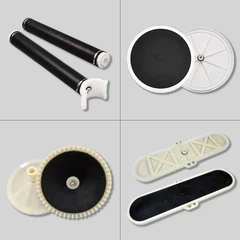
Fine bubble diffusers are available in different configurations, with differences in structure, aeration surface, and installation arrangement. The following table compares three commonly used configurations and their typical characteristics.
|
Diffuser Type |
Image |
Description |
Key Features |
Typical Applications |
|
Disc Diffusers |
Disc Diffusers |
A circular diffuser with a flexible membrane containing fine openings across the aeration surface. Multiple discs can be installed along air distribution pipes to distribute fine bubbles across the aeration tank. |
Compact structure; flexible installation density; replaceable membrane options; diffuser quantity and spacing can be adjusted according to the required aeration coverage. |
Ideal for small to medium-sized aeration tanks, retrofit projects, and applications where installation space is limited or where diffusers need to be distributed across the tank floor. |
|
Tube Diffusers |
Tube Diffusers |
membrane that releases fine bubbles along its length. Its extended aeration surface allows air to be distributed over a defined linear area. |
Long aeration surface; continuous bubble distribution; linear installation; different lengths and configurations available for different tank layouts. |
Well-suited for narrow or elongated tanks (such as oxidation ditches), deep tanks where uniform oxygen distribution along the water column is needed, and large-scale municipal or industrial plants where high oxygenation capacity is required. |
|
Plate or Panel Diffusers |
Plate or Panel Diffusers |
A flat diffuser with a planar membrane surface containing fine openings for air release. The larger surface provides a defined area for fine bubble aeration within the tank. |
Large planar aeration surface; concentrated bubble distribution; fixed mounting arrangement; suitable for layouts that can accommodate a flat diffuser assembly. |
Suitable for new installations or retrofit projects where a larger, concentrated aeration surface is preferred, or where tank geometry makes the installation of multiple disc diffusers less practical. |


What Factors Should You Consider When Selecting Fine Bubble Diffusers?
The diffuser type alone does not determine whether a fine bubble diffuser is suitable for a package sewage treatment plant. Buyers should evaluate the diffuser together with the aeration requirements, wastewater characteristics, tank layout, and operating conditions.
Aeration Demand and Airflow
The required airflow should be based on the plant's treatment capacity, oxygen demand, and aeration tank conditions. The selected diffuser should operate within an appropriate airflow range so that sufficient air can be supplied without creating unstable bubble distribution or unnecessarily high air consumption.
Diffuser Type and Tank Layout
The diffuser configuration should match the length, width, depth, and available installation area of the aeration tank. Disc diffusers can be distributed as multiple aeration points, while tube and plate configurations provide different ways of covering the available aeration area.
Bubble Size and Oxygen Transfer
Smaller bubbles generally provide a greater air-water contact area, but bubble size should be evaluated together with oxygen transfer performance and operating conditions. Buyers should compare actual oxygen transfer data under relevant water depth and airflow conditions rather than selecting a diffuser based only on its stated bubble size.
Membrane Material and Wastewater Characteristics
The membrane material should be compatible with the wastewater being treated. Factors such as organic loading, oil and grease, suspended solids, chemicals, and cleaning requirements can affect membrane durability and fouling resistance, so material selection should reflect the actual wastewater characteristics.
Pressure Loss and Blower Requirements
Diffuser pressure loss affects the pressure that the blower must provide during operation. Buyers should compare the diffuser's pressure requirements with the blower's available airflow and pressure range to ensure that the two components can operate together without excessive operating load.
Service Area and Diffuser Quantity
The number of diffusers should be determined according to the required airflow, individual diffuser capacity, and aeration coverage. Proper spacing helps distribute air more evenly throughout the tank and avoids concentrating aeration in only a limited area.
What Are the Benefits of Choosing the Right Fine Bubble Diffusers?
Choosing a suitable fine bubble diffuser can affect more than initial aeration performance. When the diffuser is properly matched to the treatment system, it can support stable operation, efficient aeration, and easier long-term maintenance.
- More Efficient Oxygen Transfer - A properly selected diffuser can provide suitable bubble formation and airflow distribution for the aeration conditions, helping transfer oxygen effectively to the wastewater and support the biological treatment process.
- More Uniform Aeration - Matching the diffuser type, quantity, and arrangement to the tank layout can help distribute air more evenly throughout the aeration zone, reducing areas with insufficient aeration.
- Lower Aeration Energy Demand - A diffuser operating within a suitable airflow and pressure range can help the aeration system avoid unnecessary air demand and reduce the risk of excessive blower loading.
- Longer Service Life - Selecting a membrane material and diffuser configuration compatible with the wastewater characteristics can help reduce premature membrane deterioration and maintain stable performance during long-term operation.
- Easier Maintenance - A suitable diffuser design can make routine inspection, cleaning, and membrane replacement more manageable, helping reduce maintenance effort and potential downtime.
Conclusion
Selecting fine bubble diffusers for a package sewage treatment plant requires looking beyond diffuser type or individual specifications. The right choice should reflect the aeration requirements, tank configuration, wastewater characteristics, and expected operating conditions so that the diffuser can work effectively as part of the overall treatment system. AquaSust provides disc, tube, and plate bubble diffuser solutions for different wastewater aeration requirements. Contact us to discuss your application and find a suitable fine bubble diffuser solution for your package sewage treatment plant.