





Introduction
Aeration typically accounts for 50%–70% of the total energy consumption of a wastewater treatment plant (industry reference data), and the type and layout of diffusers directly affect oxygen transfer efficiency and long-term operation and maintenance costs. Disc diffusers and tube diffusers are two widely used fine bubble diffuser types in blower aeration systems, and it is often difficult for selection engineers to decide between them: the two differ in oxygen transfer efficiency, layout density, suitable tank geometry, installation and maintenance, and cost, and there is no one-size-fits-all answer.

Structure and Working Principle Differences

Disc Diffuser
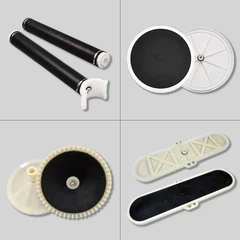
A disc diffuser consists of a round base, a clamp ring, and a membrane. Air is supplied at a single point, and bubbles are released evenly through micropores across the membrane surface, forming a fine bubble column 1–3 mm in diameter. Individual discs are compact and lightweight, so the layout density can be adjusted flexibly, making them suitable for large tank floors with high requirements for uniform air distribution.

Tube Diffuser
A tube diffuser has an elongated structure, with the membrane tube perforated evenly along its length and air typically introduced from one or both ends. Each tube delivers a high air flow rate and provides continuous air release per unit length; when laid along the length of the tank, the piping stays simple, making tube diffusers suitable for long, narrow tank configurations.
Both types commonly use EPDM (ethylene-propylene-diene monomer) or silicone membranes, which release bubbles through the elastic deformation of micropores and offer good resistance to fouling and clogging.
Core Parameter Comparison
|
Parameter |
Disc Diffuser |
Tube Diffuser |
|
Oxygen transfer efficiency SOTE (standard conditions, 4 m water depth) |
30%–45% (typical) |
28%–40% (typical) |
|
Air flow rate per unit |
0.5–3.0 Nm³/h (typical) |
2–10 Nm³/h (typical) |
|
Layout density |
Service area per disc: 0.3–0.75 m² (empirical value) |
Service area per tube: 1–2 m² (empirical value) |
|
Suitable tank types |
Large-area tanks such as square/rectangular activated sludge tanks, SBR and CASS |
Long, narrow tanks such as channel-type, plug-flow and oxidation ditch tanks |
|
Installation and maintenance |
Individual discs can be replaced independently; fixed installations require tank draining or a liftable frame for servicing |
Tube bodies are long and replacing a single tube involves dismantling piping; lift rails are recommended |
|
Cost structure |
Lower unit price per disc, but more units and more air piping and support components |
Higher unit price per tube, but fewer units and relatively simple piping |
|
Fouling resistance |
Good; membrane surfaces in dead corners at the tank floor are prone to sludge accumulation |
The area beneath the tube body is less prone to sludge accumulation; better suited to scaling-prone water quality |
Summary: At similar specifications and water depths, the difference in oxygen transfer efficiency between the two types is not large (typically about 2–5 percentage points). What really drives the selection outcome is tank geometry matching, layout cost, and operation and maintenance approach.
Applicable Scenario Analysis
Disc Diffusers: Large-Area Coverage in Activated Sludge Tanks
●Suitable for square and rectangular activated sludge tanks and intermittently operated tanks such as SBR and CASS: individual discs can be arranged flexibly for even air distribution across the entire tank floor;
●With large, regularly shaped tank floors, disc diffusers offer an advantage in air distribution uniformity and oxygen transfer efficiency;
●Field experience: municipal activated sludge tanks are typically laid out with disc diffusers at 0.5–0.75 m spacing (empirical value); coverage is easy to verify, and local densification is convenient during retrofits.
Tube Diffusers: Channels and Plug-Flow Tanks
●Suitable for long, narrow tanks such as oxidation ditches and plug-flow aeration tanks: continuous installation along the channel keeps piping short with few joints and a tidy overall layout;
●Bubbles are released evenly along the tube length and combine with the plug-flow direction, helping to maintain the velocity gradient within the channel;
●For water with high suspended solids or scaling tendency (e.g., certain industrial wastewaters), the area beneath the tube body is less prone to sludge accumulation, so maintenance intervals tend to be longer.
Hybrid Layouts
Some large projects use a combination of disc diffusers in the tank body and tube diffusers in the channels, balancing uniform air distribution with plug-flow requirements. However, this increases the complexity of design and spare-part management, and is recommended only when the process conditions genuinely require it.
Selection Recommendations and Common Pitfalls
Decision Path
1. Confirm the tank geometry and effective water depth (large square areas → prioritize disc diffusers; long narrow channels → prioritize tube diffusers);
2. Confirm the water quality (scaling-prone or high-suspended-solids water → evaluate tube diffusers first, or strengthen the anti-sludge design of disc diffusers);
3. Calculate the oxygen demand and the required total air flow, then work backward to determine the number of diffusers and the layout density;
4. Determine whether a fixed or liftable configuration is needed based on the maintenance regime (whether tank draining for servicing is allowed);
5. Compare total system cost (equipment + piping + supports + installation + energy).
Common Pitfalls
Comparing unit prices only
● Discs have a lower unit price, but there are more units and more piping and support components-compare the cost of the entire system instead;
Assuming that higher oxygen transfer efficiency is always better
● SOTE correlates strongly with water depth and air flow rate; an excessively low air flow rate actually reduces efficiency per unit of air, so verify against the design operating conditions;
Ignoring tank geometry
● Forcing disc diffusers into narrow channels leads to insufficient corner coverage or convoluted piping, which is counterproductive;
Crediting plug flow to the diffusers
● Plug flow in channels is determined mainly by the influent arrangement and tank design; diffusers play a supporting role, and the function of a single device should not be overstated.
Regional Adaptation Considerations
|
Region |
Certification/Standards |
Voltage Specification |
Selection Considerations |
|
Europe |
CE certification (EN-related standards) |
380V / 50Hz |
Municipal wastewater is relatively dilute with steady loads, and fine bubble disc diffusers are widely used; RoHS material declarations are required |
|
North America |
UL and EPA process compliance |
460V / 60Hz |
Membrane elasticity drops in cold seasons; prioritize EPDM formulations with good low-temperature performance; consider NSF material requirements |
|
Southeast Asia |
Country-dependent (CE/local standards) |
220–415V / 50Hz |
High-temperature, high-turbidity water: high water temperature lowers the DO saturation concentration, so the air flow margin must be checked; consider membrane resistance to heat aging |
|
China |
GB standards |
380V / 50Hz |
Designs align with the GB 18918-2002 discharge standard; both disc and tube diffusers are common in municipal and industrial projects |
FAQ
Q: Which has higher oxygen transfer efficiency, disc diffusers or tube diffusers?
A: Under standard conditions (4 m water depth), the typical SOTE of disc diffusers is 30%–45%, while that of tube diffusers is 28%–40%, so the gap is limited. Actual oxygen transfer performance is jointly influenced by water depth, air flow rate, membrane perforation ratio, and layout density. We recommend calculating for your specific operating conditions rather than judging by type alone.
Q: Can disc diffusers be used in oxidation ditches or channel tanks?
A: Yes, but tube diffusers match the channel shape better, with simple piping and continuous air release. In large square tanks, disc diffusers make even coverage easier to achieve. If fixed supports already exist in the channel, disc diffusers can also be arranged on custom-built frames, though the installation cost should be assessed separately.
Q: Which type should be prioritized in retrofit projects?
A: Start with the shutdown conditions: for projects where prolonged tank draining for maintenance is not allowed, prioritize liftable configurations (disc frames or tube lifting systems) that allow servicing without draining. Where draining is permitted, either fixed disc or fixed tube diffusers can work-simply compare them based on tank geometry and economics.
Conclusion
Disc and tube diffusers are not substitutes for each other-they should be matched to tank geometry and operating conditions. For large-area coverage in activated sludge tanks, evaluate disc diffusers first; for channel and plug-flow tanks, evaluate tube diffusers first. When making the decision, compare the total system cost and maintenance convenience. Taking oxygen transfer efficiency, layout density, and regional certification requirements into account, most projects can find a suitable solution among the two types.
AquaSust supplies disc diffusers, tube diffusers, and liftable aeration systems, and provides selection recommendations and solution design tailored to tank geometry, water quality, and regional standards. For a comparison selection sheet or a technical proposal, feel free to contact our technical team.